Understanding FICO’s Top Credit Score Factors
What factor has the largest impact on your credit score?
Payment history affects your score the most. It counts for 35% of your FICO Score.
FICO models treat on-time payments as the strongest signal of credit risk. A single missed or late payment that is 30 days past due can cause a sharp drop, sometimes up to 100 points in severe cases.
Key points about payment history:
- 35% of your FICO Score comes from payment history
- One late payment can stay on your reports for 7 years
- Collections, bankruptcies, and foreclosures carry a high negative impact
Examples:
- A single 30-day late mortgage payment dropped a score from 760 to 690
- Paying every credit card on time for 12 months increased a score by 40 plus points
✅ Tip: Automate payments or set alerts so nothing slips through the cracks.
How does credit utilization impact your score?
Credit utilization is the second most important factor. It makes up 30% of your FICO Score.
Credit utilization rate equals current credit card balances divided by total credit limits. Lower is better. Scores tend to benefit below 30%, and many profiles see the best results under 10%.
How FICO reads utilization
| Utilization rate | Likely score impact* |
|---|---|
| 0–9% | Positive, often optimal |
| 10–29% | Neutral to slightly positive |
| 30–49% | Negative, common 10 to 30 point dip |
| 50–100% | High negative, common 30 to 100 point dip |
*Assumes otherwise healthy credit history. Results vary by profile and model.
Examples:
- Cutting utilization from 60% to 8% raised a score from 650 to 710
- Keeping three cards under 10% each added about 15 points in 60 days
✅ Tip: Pay balances early, request responsible credit limit increases, or spread purchases across multiple cards.
How are FICO Score weights distributed across all factors?
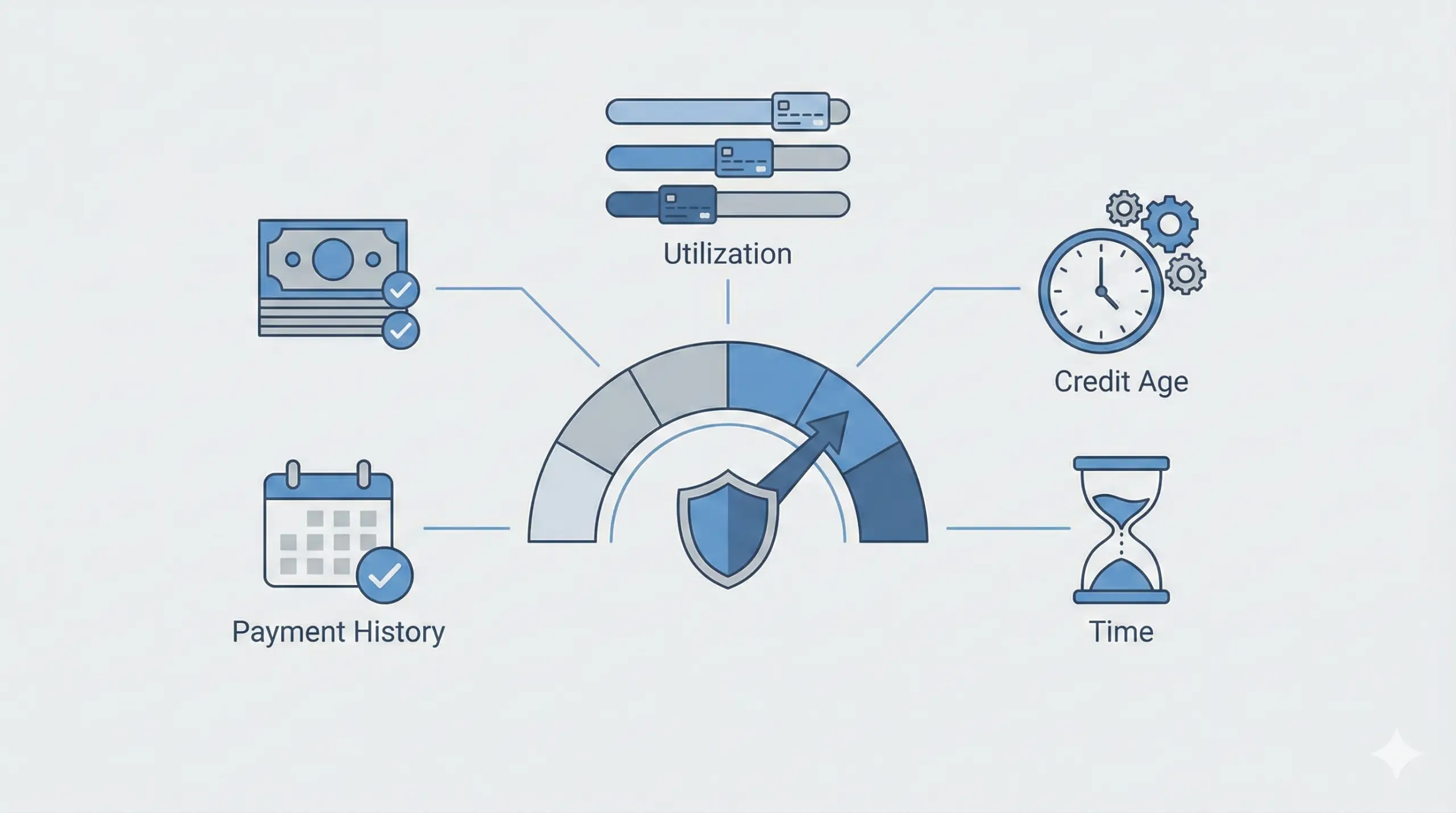
FICO Scores consider five core categories with set weightings. The table below reflects the widely used FICO 8 model.
FICO Score breakdown
| Factor | Weight | What it covers |
|---|---|---|
| Payment history | 35% | On-time vs late payments, derogatory marks |
| Credit utilization | 30% | Used credit versus available credit on revolving accounts |
| Credit age | 15% | Average age of accounts, age of oldest account |
| Credit mix | 10% | Variety of credit types, such as cards, auto, mortgage |
| New credit and inquiries | 10% | Recent applications, new accounts opened |
Note: VantageScore uses similar ingredients, but weights can differ. For example, it often puts more emphasis on total balances and recent behavior. FICO 9 and FICO 10T also consider trended data, such as how your balances change over time.
Does credit age matter as much as history and utilization?
Credit age contributes 15%, so it matters, just not as heavily as payment history or utilization.
FICO rewards long-standing accounts and a higher average age. Closing an old card can shorten your average age, which may hurt this factor.
Example scenarios:
- Keeping a 10-year-old card open supports your age factor
- Opening three new cards in one year can pull the average below two years
✅ Tip: Keep your oldest accounts open when possible, and be selective with new applications.
How do hard inquiries and new accounts affect your score?
Hard inquiries and new credit account for 10% of your score.
When you apply, the lender runs a hard inquiry that can trim about 3 to 5 points for a short period. Multiple hard pulls in a tight window can hit harder unless they’re treated as one for rate-shopping.
Impacts of new credit:
- Opening several accounts within 6 to 12 months can signal higher risk
- FICO groups mortgage, auto, and student loan inquiries within a rate-shopping window, typically 14 to 45 days depending on the scoring model
✅ Tip: Space out applications and avoid unnecessary pulls.
How does credit mix influence your credit score?
A healthy credit mix makes up 10% of your FICO Score.
Lenders like to see that you can handle different types of credit.
Revolving accounts:
- Credit cards, HELOCs
Installment loans:
- Auto, mortgage, student loans
Examples of positive mix:
- Two credit cards, one auto loan, and a mortgage often score better than cards alone
- Five retail cards with no installment history can look riskier
✅ Tip: If your file lacks variety, consider a small installment or credit-builder loan.
What affects a credit score the fastest?
Lowering high utilization usually moves scores the fastest in a positive direction.
When card issuers report lower balances, you can see improvement within one billing cycle. Late payments take much longer to fade, since they can remain for up to 7 years.
Fast actions that can help:
- Pay down high-balance cards
- Increase credit limits while keeping usage low
- Become an authorized user on an older, well-managed card
- Dispute inaccurate derogatory marks
What damages your credit score the most?
The biggest score drops come from missed payments, defaults, and high utilization.
Negative records include:
- 30 plus day late payments
- Charge-offs or collections
- Maxed-out cards
- Bankruptcy, foreclosure, or repossession
Estimated point impact by action
(Actual impact varies by profile, recency, and model.)
| Action | Estimated score drop |
|---|---|
| 30-day late payment | 60 to 100 points |
| Account sent to collections | 70 to 120 points |
| Maxing out a card, 100% usage | 30 to 75 points |
| Bankruptcy | 130 to 200 plus points |
Summary, what impacts your FICO Score the most?
| Factor | Weight | Impact potential | Actionable tip |
|---|---|---|---|
| Payment history | 35% | Very high, most sensitive factor | Always pay on time, avoid missed payments |
| Credit utilization | 30% | High, quick changes possible | Keep balances under 10% to 30% |
| Credit age | 15% | Moderate, long-term factor | Keep old accounts open |
| Credit mix | 10% | Moderate, adds depth | Use both revolving and installment credit |
| New credit | 10% | Lower, usually short-term | Space out applications |
Up next: how often scores update, and how fast you can recover after a negative mark.