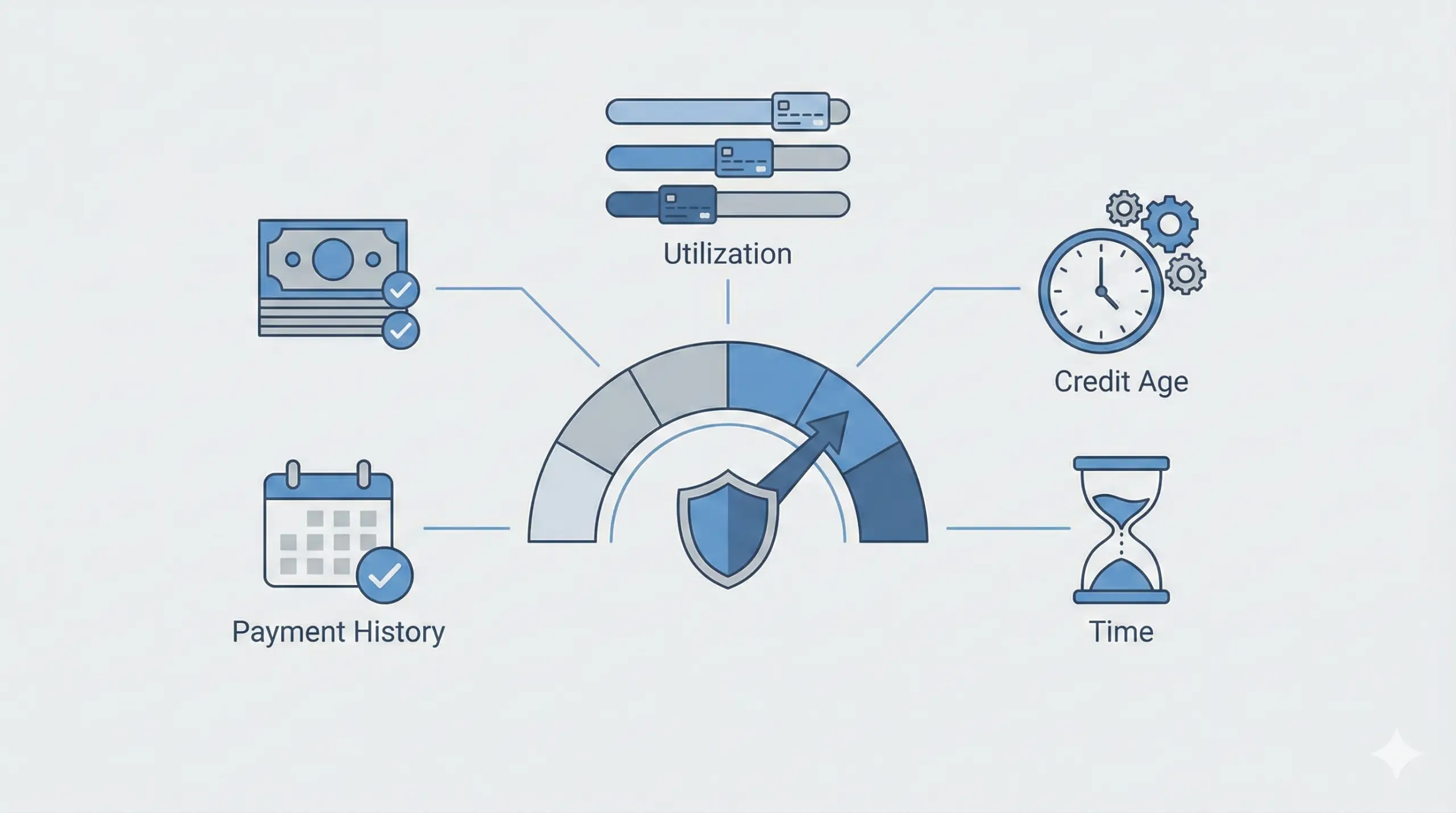
Quick answer: FICO credit scores range from 300 to 850. Poor is 300–579, Fair 580–669, Good 670–739, Very Good 740–799 and Exceptional 800–850. VantageScore also runs from 300 to 850 but labels the ranges differently, as shown below.
Credit Score Ranges in 2026: FICO vs. VantageScore
| FICO Score range | FICO rating | VantageScore range | VantageScore rating |
|---|---|---|---|
| 800–850 | Exceptional | 781–850 | Excellent |
| 740–799 | Very Good | 661–780 | Good |
| 670–739 | Good | 601–660 | Fair |
| 580–669 | Fair | 500–600 | Poor |
| 300–579 | Poor | 300–499 | Very Poor |
The two scales don’t line up exactly. A 600 is “Fair” on FICO’s scale but “Poor” on VantageScore’s, and a 790 is “Very Good” on FICO but “Excellent” on VantageScore. When you see a score, check which model produced it.
What Each Credit Score Level Means for Borrowing
- 800–850 (Exceptional): You’ll usually qualify for the lowest advertised rates and the best credit card offers.
- 740–799 (Very Good): Most lenders give you their best or near-best pricing; on mortgages, 740+ often removes most credit-based price adjustments.
- 670–739 (Good): Approval is likely for most products, but rates are somewhat higher than for top scores.
- 580–669 (Fair): You can often qualify for FHA mortgages (580+ for 3.5% down) and some credit cards and loans, but expect higher rates, fees or deposits.
- 300–579 (Poor): Approval is difficult; secured credit cards and credit-builder loans are the usual starting point.
Credit scores reflect your creditworthiness. Lenders use them to assess risk before offering loans or credit. The most used credit scoring model is the FICO Score, ranging from 300 to 850. Higher scores indicate lower risk for lenders.
What Is a Credit Score?
A credit score is a numerical value based on your credit behavior. It summarizes your history of managing debt.
Credit scores are calculated using information in your credit report, including payment history, debt levels, and credit age. Scores are used by banks, insurers, landlords, and even employers.
What Factors Affect Your Credit Score?
Direct Answer: Five main factors affect your FICO Score. Each factor carries a different weight.
| Factor | Weight in FICO Score | Description |
|---|---|---|
| Payment History | 35% | Tracks on-time vs. late payments |
| Amounts Owed | 30% | Measures credit utilization ratio |
| Length of Credit History | 15% | Considers average age of credit accounts |
| Credit Mix | 10% | Evaluates types of credit used (loans, cards, etc.) |
| New Credit | 10% | Looks at recent applications and new accounts |
These percentages apply to most scoring models, including FICO 8 and FICO 9.
What Is the FICO Score?
Direct Answer: The FICO Score is a proprietary credit scoring model developed by Fair Isaac Corporation.
FICO Scores are used in over 90% of U.S. lending decisions. They analyze information from your credit reports maintained by the three major bureaus:
- Equifax
- Experian
- TransUnion
There are multiple versions of FICO Scores:
- FICO Score 8: Most commonly used model
- FICO Score 9: Includes rental payments and medical debt adjustments
- Industry-specific versions: Used for auto loans or credit cards
What Is a Credit Report?
Direct Answer: A credit report is a detailed file summarizing your credit history.
The report includes:
- Personal identification data
- Open and closed credit accounts
- Credit limits and balances
- Payment history
- Collection accounts
- Public records (bankruptcies, judgments)
- Credit inquiries (soft and hard)
Each of the three credit bureaus issues its own version of your credit report. Errors can appear due to reporting differences. Consumers are entitled to one free report annually from each bureau via AnnualCreditReport.com.
How Is Credit Score Calculated From a Credit Report?
Direct Answer: Scoring models extract key data points from credit reports to compute a score using proprietary algorithms.
Examples:
- A missed payment in the last 6 months lowers your Payment History score.
- Maxing out a credit card increases your Credit Utilization rate, lowering the Amounts Owed component.
- Keeping old accounts open boosts the Length of Credit History factor.
Each bureau may report data differently, resulting in slightly different FICO scores per bureau.
What Lowers Your Credit Score the Most?
Direct Answer: The most damaging factors are:
- Late payments (especially 60+ days overdue)
- High credit utilization (over 30% usage of available credit)
- Collection accounts or charge-offs
- Bankruptcies, liens, and foreclosures
- Frequent hard inquiries within a short period
Each of these can drop a score by 30 to 200 points depending on severity.
How Long Do Negative Items Stay on a Credit Report?
| Item Type | Duration on Report |
|---|---|
| Late Payments | Up to 7 years |
| Collections | 7 years |
| Chapter 7 Bankruptcy | 10 years |
| Chapter 13 Bankruptcy | 7 years |
| Hard Inquiries | 2 years |
| Foreclosures | 7 years |
Credit impact fades over time if good habits follow.
How Can You Improve Your Credit Score?
Direct Answer: Improve your credit score by modifying credit habits that impact scoring factors.
Key actions:
- Pay all bills on time
- Reduce credit card balances below 30%
- Avoid new hard inquiries
- Maintain old credit accounts
- Diversify your credit mix if limited
- Dispute any errors in your credit report
FICO updates scores monthly if lenders update the data.
Who Creates and Maintains Credit Scores?
- Fair Isaac Corporation (FICO): Created FICO Scores used by lenders globally
- Credit Bureaus (Equifax, Experian, TransUnion): Provide the credit report data used in score calculation
- VantageScore: Competing model developed by the three major bureaus
FICO and VantageScore use similar data but different algorithms.
Do All Lenders Use the Same Credit Score?
Direct Answer: No, lenders choose different scoring models and versions.
Examples:
- A mortgage lender may use FICO Score 2, 4, and 5
- Auto lenders often use FICO Auto Score 8
- Credit card issuers may use FICO Bankcard Score 8 or 9
Lenders may check one bureau or all three.
Can You Check Your Credit Score for Free?
Yes, free tools include:
- Credit card dashboards (Discover, Capital One, etc.)
- FICO Open Access program
- Credit monitoring services (Credit Karma, Credit Sesame — VantageScore)
- Banks or credit unions (often offer free access to your FICO Score)
Each service may show a different model.
Is VantageScore the Same as FICO?
Direct Answer: No. VantageScore is a separate model with different scoring criteria.
Key differences:
| Feature | FICO Score | VantageScore |
|---|---|---|
| Developer | Fair Isaac Corporation | Equifax, Experian, TransUnion |
| Score Range | 300–850 | 300–850 |
| Minimum Credit History | 6 months | 1 month |
| Late Payment Impact | High | Higher for recent late payments |
VantageScore is gaining adoption, but FICO remains dominant in lending.
What Is a Good Credit Score to Buy a House?
Direct Answer: A FICO Score of at least 620 is required for most conventional mortgages.
Details:
- FHA loans: minimum 580 with 3.5% down
- VA loans: no minimum, but 620+ recommended
- Jumbo loans: often require 700+
- Better rates usually require 740+
How Often Does Your Credit Score Change?
Direct Answer: Credit scores update when lenders report new data, typically every 30 days.
Common triggers:
- New payments or missed payments
- Balance changes
- New credit accounts
- Account closures
- Credit limit increases
The timing depends on each lender’s reporting cycle.
What Is Credit Utilization and Why Does It Matter?
Direct Answer: Credit utilization is the ratio of used credit to available credit. It accounts for 30% of your FICO Score.
Example:
- Credit limit: $10,000
- Balance: $3,000
- Utilization rate: 30% (maximum recommended)
Lower utilization signals responsible usage. High usage can indicate financial distress.
Credit Score Range FAQs
What is a 603 credit score?
A 603 is a Fair score on both the FICO scale (580–669) and the VantageScore scale (601–660). It’s typically enough for an FHA mortgage, but many conventional loans require at least 620, and you’ll usually pay higher rates on cards and personal loans. Paying down card balances and avoiding late payments are the fastest ways to move up.
What is a good credit score?
On the FICO scale, 670 or higher is considered good. A score of 740+ usually earns the best pricing on mortgages, auto loans and cards.
Why do I have different credit scores?
You have many scores, not one. FICO and VantageScore use different formulas, each comes in several versions (such as FICO 8, FICO 9 and the older FICO 2, 4 and 5 used for mortgages), and each of the three bureaus may hold slightly different data about you.
Do mortgage lenders use FICO or VantageScore?
Most mortgage lenders still use the older FICO models (FICO 2, 4 and 5). In 2025, the agency that oversees Fannie Mae and Freddie Mac also allowed lenders to use VantageScore 4.0, so you may see either, depending on the lender.
What is the highest possible credit score?
850 on both the base FICO Score and VantageScore 3.0/4.0. Some industry-specific FICO scores, such as auto and bankcard scores, range from 250 to 900.
📖 Complete guide: How to Improve Your Credit Score: The Complete 2026 Guide
Related: What Affects Your Credit Score The Most · How To Improve Credit Score Fast · Credit Utilization Ratio What It Is And How To Lower It