What Happens After a Credit Card Charge-Off? The Complete Guide to What It Means and What to Do Next
A credit card charge-off is an accounting reclassification by the original creditor — not debt forgiveness. The debt remains legally owed, continues to accrue consequences on your credit report, and typically moves to a third-party collector. Here is exactly what happens after a charge-off and the specific steps that produce the best outcomes.The term “charge-off” sounds conclusive. It sounds like something has ended. For many borrowers, the moment they see it on their credit report, the natural assumption is that the account has been closed out — that the bank has written off the debt and moved on.
That assumption is incorrect, and acting on it is among the most costly mistakes a borrower in this situation can make. Understanding what a charge-off actually is — what it means for your legal obligation, your credit profile, and your relationship with whoever now owns the debt — is the prerequisite for responding to it strategically.
What a Charge-Off Actually Is: The Accounting Reality
A charge-off is an internal accounting action. When a creditor charges off an account, they reclassify the outstanding balance from an asset on their books to a loss. This reclassification is required by federal banking regulations — specifically, most credit card issuers are required to charge off accounts at 180 days of non-payment. What a charge-off does not do:- It does not extinguish your legal obligation to repay the debt
- It does not prevent the creditor from continuing to collect
- It does not prevent the debt from being sold to a third-party collector
- It does not remove the debt from your credit report
After charging off the account, the original creditor has two options:
Continued collection through an assigned agency: The creditor retains ownership of the debt but contracts a third-party agency to collect on their behalf, typically on a contingency fee basis. The original creditor remains the owner. Sale to a third-party debt buyer: The creditor sells the debt outright — typically for 3% to 15% of face value depending on age, documentation quality, and portfolio characteristics. The debt buyer becomes the legal owner and has the right to collect the full face value. Their cost basis is a fraction of what they are claiming — a fact that creates significant negotiating leverage for the borrower.The Immediate Credit Report Impact
What Appears on Your Report
Your credit report will reflect multiple negative entries from the same charge-off event: The original account entry shows the complete payment history leading to the charge-off — a sequence of 30-day, 60-day, 90-day, 120-day, and 150-day late payment marks, followed by the charge-off status itself. Each of these marks is a separate negative entry. Payment history accounts for approximately 35% of your FICO score — the largest single factor — making this sequence of entries among the most damaging events in credit scoring. The collection account entry from the third-party collector or debt buyer is reported separately under the collector’s name. This appears as a distinct collection account with its own entry on your report.Both entries run on the same seven-year clock from the date of first delinquency — not the date of the charge-off, not the date the collection account was opened. The date of first delinquency is the date of the first missed payment that led, without being subsequently brought current, to the eventual charge-off.
The Score Impact Trajectory
The most severe score impact from a charge-off typically occurs when the charge-off notation first appears — at the 180-day mark — though the damage from the preceding late payment marks has been accumulating for months before that. A borrower who was current prior to the delinquency sequence can lose 100 to 150+ points by the time the charge-off is reported.The impact diminishes progressively over time, even before the entry ages off. A charge-off that is five years old affects your score less than one that is one year old, assuming consistent positive behavior has accumulated alongside it. This progressive diminishing is an important reason to focus on building positive history immediately, rather than treating the seven-year window as a period of waiting.
What Happens Next: The Collection Process
The Transition to Third-Party Collection
When a charged-off debt is sold to a debt buyer or assigned to a collection agency, you will begin receiving contact from an entity you have no prior relationship with. Their communication will typically begin with a written validation notice — which they are legally required to send within five days of first contact under the Fair Debt Collection Practices Act (FDCPA).This validation notice triggers your most important procedural right: a 30-day window during which you can request debt validation in writing, and the collector must cease all collection activity until they provide it.
This 30-day window is the single most important protective mechanism in the post-charge-off process. If you receive any written notice from a collection agency, identify the date received and calendar your 30-day deadline immediately.
Debt Validation: Your First Action
Before making any financial decision about a charged-off debt — before negotiating, before paying, before acknowledging the debt in any way — request debt validation from the collector in writing.Send your request via certified mail with return receipt requested. Keep a copy. Request that the collector provide:
- Documentation confirming their legal right to collect this specific debt (assignment or purchase agreement from the original creditor)
- A complete accounting of the balance claimed, showing how each component was calculated — including any fees or interest added after the charge-off
- The name and address of the original creditor
- The date of first delinquency
- Confirmation that the collector is licensed to collect debts in your state (where state licensing is required)
Any inaccuracy revealed through validation is grounds for a credit bureau dispute — and potentially for removal of the collection entry without payment.
Evaluating the Statute of Limitations
Before making any payment decision, verify the statute of limitations on the debt in your state.The statute of limitations is the period during which a creditor can successfully file a lawsuit and obtain a judgment. It varies by state and debt type — typically two to six years for credit card debt, though some states apply longer periods.
If the debt is within the statute of limitations: The lawsuit risk is real. Collectors with balances above their internal filing thresholds (commonly $1,000 to $3,000) do pursue litigation, and a judgment enables wage garnishment and bank account levy. Resolution reduces this risk. If the debt is past the statute of limitations: The collector cannot obtain a court judgment. The legal collection pathway has expired. The debt still appears on your credit report (until the seven-year window closes), and collectors can still contact you and request voluntary payment — but they cannot win in court. The restart risk: In many states, making any payment on a time-barred debt restarts the statute of limitations, reviving the collector’s ability to sue. A partial payment intended as a goodwill gesture on an account past the limitation period can inadvertently restore full legal collection risk. Verify your state’s rules before making any payment on a debt that may be near or past the limitation period.Your Resolution Options: From Best to Most Limited
Option 1: Dispute Inaccuracies and Potentially Remove Without Payment
If validation materials reveal inaccuracies — or if your credit report shows incorrect information in the charge-off or collection entries — file disputes with the credit bureaus before making any payment. A successfully disputed inaccurate entry is removed from your report without payment, which is the best possible outcome.Common disputable inaccuracies include: incorrect date of first delinquency, balance amounts that include unauthorized charges, duplicate entries for the same underlying debt, re-aged reporting dates, and entries from collectors without documented right to the debt.
File disputes with each bureau separately — the same account may be reported differently across Equifax, Experian, and TransUnion. Send disputes via certified mail with documentation. Bureaus are required to investigate within 30 days (45 days if additional information is provided) and correct or remove information they cannot verify.
Option 2: Negotiate Pay-for-Delete
A pay-for-delete agreement exchanges payment of the debt — in full or at a negotiated settlement amount — for the collector’s commitment to request complete deletion of the collection account from your credit reports. Deletion produces maximum credit score improvement under every scoring model, because a deleted account is no longer in the data being evaluated.Pay-for-delete is not a legal right. It is a negotiated outcome. Third-party debt buyers — particularly those who purchased the debt at significant discount — have the most financial flexibility to agree. Major bank collections departments typically decline.
Negotiation approach: Request pay-for-delete in writing. Offer a specific settlement amount — collectors on purchased debt often accept 40% to 60% of the face value on older accounts, though the range varies. State that your offer is conditional on written confirmation of deletion before any payment is made. Critical requirement: Obtain the pay-for-delete agreement in writing, on company letterhead, with the specific terms — payment amount, accounts to be deleted, bureaus from which deletion will be requested, and the timeframe — before any payment is transferred. Verbal promises from phone representatives are not reliably enforceable.After payment, verify deletion by pulling all three bureau reports 30 to 60 days later. If deletion has not occurred, follow up with your written agreement as documentation.
Option 3: Settle for Less Than Full Balance
If pay-for-delete is unavailable, negotiating a settlement — paying a percentage of the claimed balance to close the account — is still financially beneficial. The account status updates from unpaid to “Settled” or “Settled for Less Than Full Amount,” which performs better than an unpaid charge-off in manual underwriting and, under newer FICO 9 and VantageScore models, eliminates the scoring penalty entirely.Settlement amounts typically range from 30% to 60% of the claimed balance for third-party debt buyers, though this varies with the debt’s age, the collector’s cost basis, and the borrower’s available lump sum.
The lump-sum advantage: Settlement discounts are available for immediate lump-sum payments, not installment arrangements. Collectors accept lower percentages for cash available now than for payment plans spread over months. Know exactly what you can pay immediately before entering any negotiation. Tax implication: Forgiven debt is generally treated as ordinary income by the IRS. If you settle a $6,000 balance for $2,500, the $3,500 difference may be reported on Form 1099-C and added to your taxable income for that year. The insolvency exception may eliminate or reduce this obligation for genuinely insolvent borrowers. Consult a tax professional before finalizing any significant settlement.Option 4: Wait for Natural Aging
Every charge-off and associated collection account will age off your credit report seven years after the date of first delinquency — regardless of payment status. For time-barred debts near their reporting window expiration, and for borrowers with no immediate credit applications planned, waiting for natural expiration may be the most rational financial choice.Calculate the exact removal date (date of first delinquency + 7 years), set a calendar reminder for one month before this date, and verify removal from all three bureau reports when the date passes. If the entry has not been removed after seven years, dispute it with the bureaus as information exceeding the legal reporting window.
Payment Execution: Protecting Yourself When You Pay
Always Get the Agreement in Writing First
The written settlement agreement must include: the exact payment amount, explicit language confirming this constitutes “full and final settlement” with no remaining balance to be owed or sold, the credit reporting outcome, and the collector’s authorized signature. No payment by any method should precede this document.Use a Controlled Payment Method
Pay via cashier’s check, money order, or a documented electronic payment to the collector’s verified portal. Do not provide your checking account routing and account numbers directly. Cases of collectors withdrawing amounts beyond what was agreed are documented and reported. The written agreement and a controlled payment method are your protection.Retain all payment documentation permanently: the written agreement, the payment instrument or confirmation, and any receipt from the collector. This documentation may be needed for credit report disputes, tax purposes, or future lender verification of the account’s resolution.
Credit Recovery: Building Positive History After a Charge-Off
Resolution of the charge-off addresses the negative entry. Building positive history alongside it — beginning immediately — is what produces the credit recovery trajectory over the months and years that follow.Maintain Perfect Payment History on Every Active Account
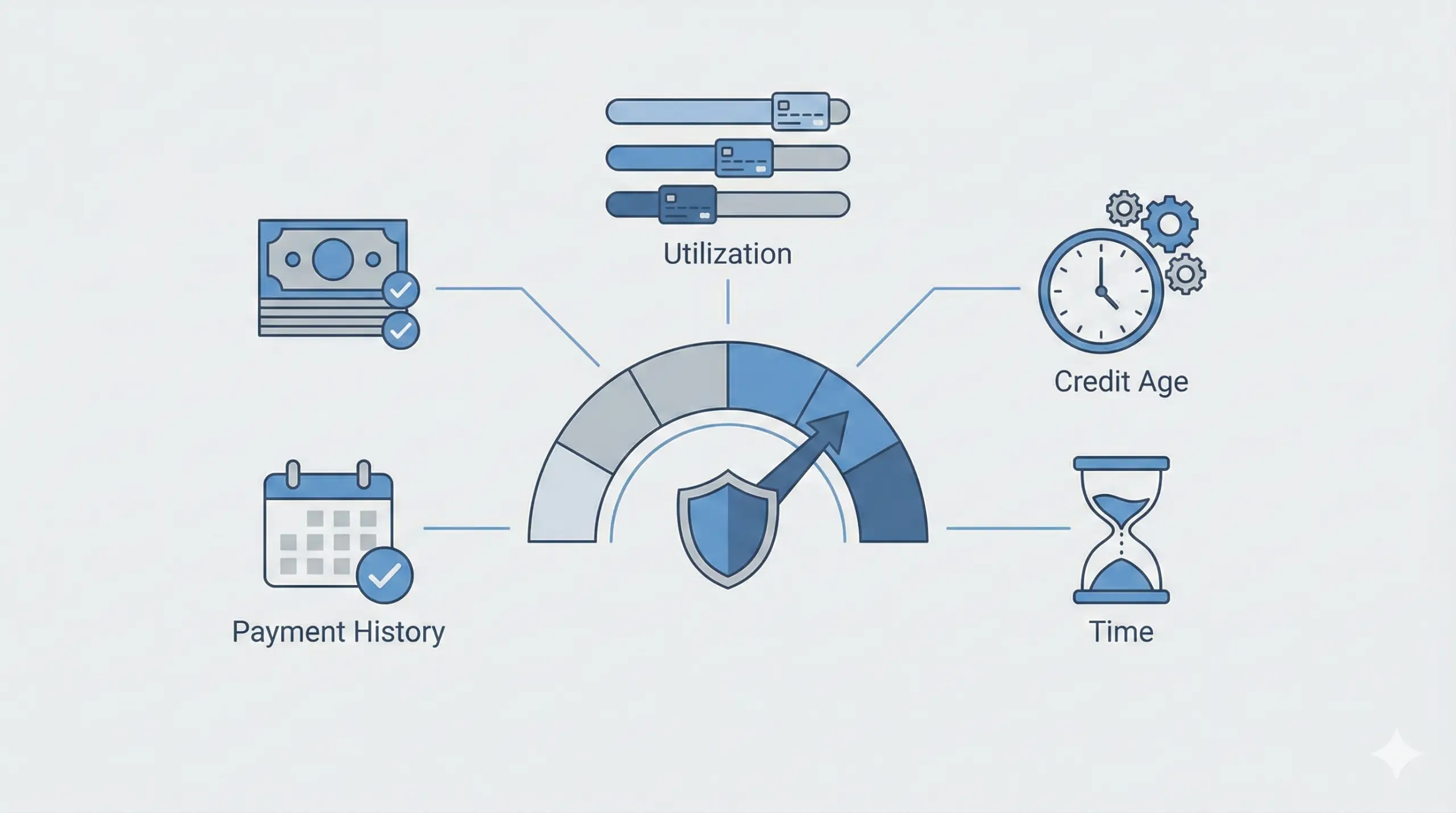
Payment history is the largest factor in your FICO score, at approximately 35%. A single 30-day late mark on an active account can produce more immediate score damage than a resolved charge-off produces improvement. Automate minimum payments on every current account without exception.Manage Revolving Credit Utilization Actively
Credit utilization — the ratio of your revolving balances to your total credit limits — accounts for approximately 30% of your FICO score and is the fastest-moving factor available for deliberate improvement. Keeping balances below 30% — ideally below 10% — of your total limits produces meaningful score improvement within a single billing cycle. Pay revolving balances before your statement closing dates (not just by the payment due date) to ensure lower balances are reported to the bureaus.Add a Secured Credit Card if Your Active Tradelines Are Limited
For borrowers whose active, positive-reporting credit accounts are thin or nonexistent after a charge-off, a secured credit card — backed by a cash deposit that serves as the credit limit — provides a vehicle for building consistent positive payment history. Use it for a small, fixed monthly expense. Pay the balance in full before the statement closing date every month. The positive payment history accumulates in your credit file, progressively diluting the relative weight of the charge-off.Avoid Retirement Fund Withdrawals to Pay the Debt
Liquidating retirement accounts — 401(k)s, IRAs — to pay a charged-off credit card debt subjects the withdrawal to ordinary income tax, an early withdrawal penalty of 10% (for accounts accessed before age 59½), and permanently removes compounding growth from your retirement savings. The financial cost of this approach almost always exceeds the financial benefit of resolving the credit card debt, particularly when settlement at a reduced percentage is available.Frequently Asked Questions
My charge-off is from the original creditor and shows as “charged off” — but I’m also seeing a collection account from a different company. Are these the same debt?
Yes, in most cases. The charge-off entry from the original creditor and the collection account from the third-party collector reflect the same underlying debt. Both entries are subject to the same seven-year reporting window from the date of first delinquency. If the collection account shows a more recent date of delinquency than the original account — indicating it has been re-aged — this is disputable with the bureaus.Can I negotiate directly with the original creditor after a charge-off?
In some cases, particularly when the account has been assigned rather than sold, the original creditor retains ownership and has authority to negotiate. If the debt was sold outright to a debt buyer, the original creditor has no remaining financial interest and typically cannot negotiate on the account. Confirm who currently owns the debt — through your credit report and through validation — before determining who to contact.How long before my credit score shows meaningful improvement after resolving a charge-off?
The timeline depends on what happens to the account entry and what else is in your credit profile. If the charge-off is deleted through pay-for-delete, the improvement is typically reflected within one to two billing cycles following deletion. If the account is updated to paid/settled status, the improvement is more gradual — and depends significantly on which scoring model evaluates your profile. Consistent positive behavior across all active accounts produces compounding improvement over 12 to 24 months that often substantially outweighs the single charge-off’s diminishing impact.This article is intended for informational purposes only and does not constitute legal or financial advice. Credit reporting laws, debt collection practices, and tax rules vary by jurisdiction and are subject to change. Please consult a qualified financial advisor, consumer protection attorney, or tax professional for guidance specific to your situation.
📖 Complete guide: Debt Management: The Complete 2026 Guide
Related: Understanding Charge Off Debt A Guide To Financial Recovery · What Happens When Debt Goes To Collections A Professional Guide · Should You Pay Collections A Guide To Rebuilding Your Credit