It’s one of the most common questions in personal finance, and the answer is almost never as simple as people hope: does paying off debt increase your credit score?
The truthful answer is: usually yes, sometimes immediately, sometimes gradually, and occasionally — in ways that surprise people — a brief dip before the long-term improvement materializes. Understanding exactly why each of these outcomes happens is what separates borrowers who manage their credit strategically from those who make well-intentioned moves that produce unexpected results.
This guide breaks down the mechanics completely — what changes when you pay off different types of debt, what the timing looks like, where the traps are, and how to approach repayment in a sequence that produces the best possible credit score outcome.
Why Debt Repayment Affects Your Credit Score: The Underlying Logic
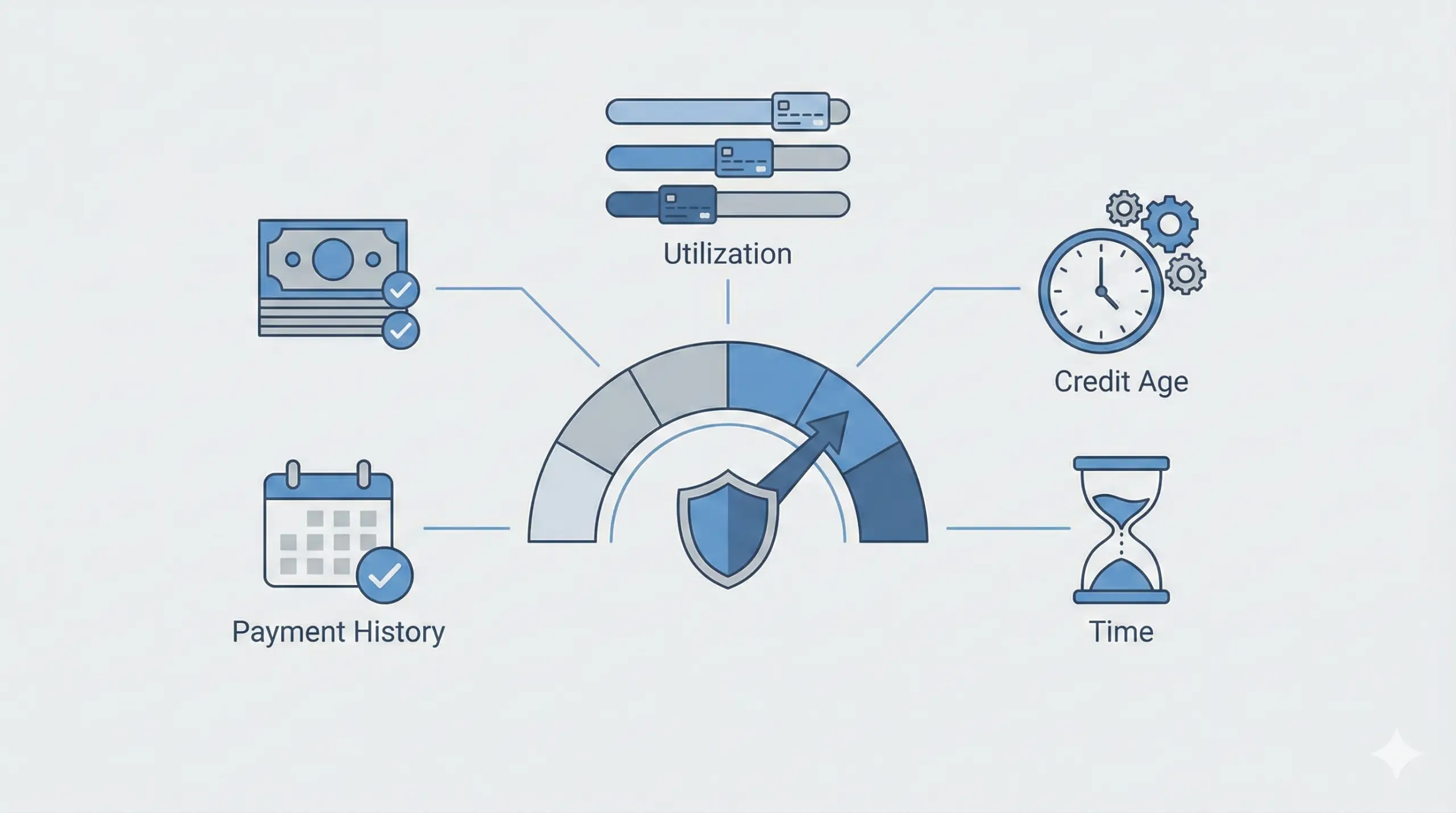
Credit scoring models are designed to predict the statistical probability that a borrower will miss a payment in the next 24 months. Every piece of information in your credit report is evaluated through that lens.When you reduce your debt — particularly your revolving credit card balances — you change several signals that scoring models monitor closely:
- Your credit utilization rate decreases, which is one of the two most heavily weighted factors in your score
- Your available credit increases, which changes how lenders perceive your capacity to absorb additional obligations
- Your monthly minimum payment obligations decrease, improving your debt-to-income picture for underwriting purposes
Revolving Debt vs. Installment Debt: The Distinction That Changes Everything
Not all debt repayment produces the same scoring effect. The type of debt matters enormously.Paying Off Revolving Debt (Credit Cards and Lines of Credit)
This is where debt repayment has its most direct, most immediate, and most significant impact on your credit score.Revolving debt — credit cards, personal lines of credit, home equity lines — is the primary driver of your credit utilization rate, which accounts for approximately 30% of your FICO score. The calculation is straightforward:
$$\text{Utilization Rate} = \frac{\text{Total Revolving Balances}}{\text{Total Revolving Credit Limits}} \times 100$$
When you reduce your credit card balances, your utilization rate drops. When your utilization drops, your score typically improves — often within a single billing cycle, as soon as the updated balance is reported to the bureaus.
The magnitude of the improvement depends on how much your utilization changes. Moving from 70% to 25% produces a substantially larger score improvement than moving from 25% to 18%. The most impactful improvements occur when high utilization is brought below the 30% threshold, and further gains are achieved by targeting the sub-10% range.
Critically, scoring models evaluate utilization both in aggregate (across all revolving accounts combined) and per account (on each individual card). A single card sitting at 85% utilization creates a negative per-account signal even if your total aggregate utilization looks reasonable. Paying down the highest-utilization individual accounts produces disproportionately strong scoring improvements.
Paying Off Installment Debt (Mortgages, Auto Loans, Student Loans)
The impact here is more nuanced and less immediate.Installment loans — debt with a fixed repayment schedule and a defined end date — are not part of the credit utilization calculation. Paying down the principal on your mortgage or student loan does not change your utilization rate.
What paying off installment debt does affect:
- Payment history: Consistent on-time payments on installment accounts contribute positively to the most heavily weighted scoring factor over time
- Debt-to-income ratio: Your DTI improves as installment payment obligations are eliminated, which matters for underwriting on future applications even if it doesn’t directly change your score
- Credit mix: This is where a counterintuitive effect can appear — more on this shortly
The Counterintuitive Scenarios: When Paying Off Debt Can Temporarily Lower Your Score
This is the part most credit guidance glosses over — and it catches people off guard.Closing a Credit Card After Paying It Off
The instinct to close a credit card account once the balance reaches zero is understandable. The account is paid off; closing it feels like a clean conclusion. In credit score terms, this can be a costly mistake.When you close a revolving account, its credit limit is removed from your total available credit. If you still carry balances on other cards, your utilization rate increases immediately — not because you spent more, but because your total available credit shrank. Simultaneously, closing an account removes it from your average age of accounts calculation, potentially reducing the length of your credit history.
The consistently better approach: Keep paid-off credit card accounts open. Put a small recurring charge — a streaming subscription, a monthly utility — on the card and set it to autopay in full. The account remains active, the limit continues to support your total available credit, and the card’s history continues to contribute positively to your credit profile.Paying Off Your Only Installment Loan
Credit scoring models reward credit mix — the management of different types of credit obligations. A profile that includes both revolving accounts and installment accounts demonstrates a broader range of credit management competence than revolving-only or installment-only profiles.When you pay off your only installment loan, that account eventually closes and the installment element of your credit mix disappears. Depending on your overall profile, this can produce a small score reduction — not because you did something wrong, but because the diversity of your credit history decreased.
This is a minor and often temporary effect, and it absolutely should not discourage you from paying off installment debt. The cash flow benefits and the overall financial improvement of eliminating an installment obligation are real and lasting. The credit mix adjustment, when it occurs, is typically small and often reverses as your profile continues to develop.
Timing Delays Between Payment and Score Update
Credit score changes do not happen instantaneously. Your credit card issuer typically reports your updated balance to the bureaus once per month, usually on or around your statement closing date. If you pay down a balance today, it may be 30 to 45 days before that change is reflected in your credit score.This lag creates a common source of confusion: a borrower makes a significant payment, checks their score a few days later, sees no change, and concludes the payment didn’t help. It helped — the score just hasn’t updated yet. Patience is essential when monitoring score changes after debt repayment.
The AZEO Strategy: The Most Effective Utilization Optimization Technique
For borrowers who want to maximize their credit score in the near term — before a mortgage application, for example, or when qualifying for a major credit product — the All Zero Except One (AZEO) method is the most consistently effective approach.The strategy: pay all revolving account balances to zero before the statement closing dates for each account, leaving exactly one card with a very small balance — typically between 1% and 5% of that card’s limit.
Why this works:- All accounts at zero: Your aggregate utilization drops to nearly nothing
- One account with a minimal balance: You demonstrate active, current use of revolving credit rather than complete non-use — avoiding the slightly less favorable signal of 0% utilization on every card
- Individual accounts at zero: The per-account utilization signal is optimized across almost every card simultaneously
This approach is most relevant for borrowers actively preparing for a specific credit application. For ongoing credit management, consistently maintaining utilization below 10% across accounts produces similar long-term results.
Statement Closing Date Timing: The Detail That Determines What Gets Reported
Understanding when to make payments is as important as how much to pay.Your credit card issuer reports your balance to the credit bureaus on your statement closing date — the last day of your billing cycle, when your monthly statement is generated. This is the balance that appears in your credit report and factors into your utilization calculation. It is not your balance after you make your payment by the due date.
The practical implication: A borrower who charges $4,000 to a card with a $5,000 limit throughout the month, then pays the full balance by the due date, may still be reporting 80% utilization if the statement closed before the payment was received.To control what the bureaus see:
- Identify the statement closing date for each of your cards (visible on any recent statement or in your online account portal)
- Pay your balance down to your target utilization level before that date — not simply before the payment due date
- Pay any remaining balance by the due date to avoid interest
Strategic Sequencing: How to Order Your Debt Repayment for Maximum Score Impact
If you are allocating extra funds toward debt repayment and want to optimize both your credit score and your overall financial position, the sequence matters.For Maximum Credit Score Improvement (Near-Term Focus)
- Address individual cards above 50% utilization first — these are producing the most significant per-account negative signals
- Bring all cards below 30% — crossing this threshold produces the next tier of scoring improvement
- Push aggregate utilization toward 10% — this achieves the most favorable scoring range
- Apply AZEO timing before statement closes — maximize the score at the specific moment it matters most (before an application)
For Maximum Financial Benefit (Long-Term Focus)
The debt avalanche method directs extra payments toward the account with the highest interest rate first, minimizing total interest paid over time. This is mathematically optimal — you pay less total money to eliminate the same debt load.The debt snowball method directs extra payments toward the smallest balance first, producing faster early payoffs that many borrowers find motivating. Behavioral consistency matters more than mathematical perfection; the best method is the one you actually sustain.
For borrowers with high-interest revolving debt (credit card APRs often ranging from 18% to 28%), combining the avalanche approach with aggressive paydown before statement close provides both credit score improvement and maximum interest savings simultaneously.
Paying Off Debt vs. Building an Emergency Fund: How to Think About the Trade-off
A question that arises frequently alongside debt repayment strategy is whether available funds are better directed toward eliminating debt or building a cash reserve. The general framework:For high-interest revolving debt — credit card balances at 18% to 28% APR — paying the balance down produces a guaranteed return equivalent to the interest rate avoided. No risk-free investment currently produces returns of this magnitude. Prioritizing high-interest debt elimination is typically the right financial decision.
For low-interest installment debt — mortgages, federal student loans, auto loans at rates below 6% to 8% — the calculus changes. The marginal benefit of accelerating these payoffs is lower, and maintaining a cash reserve provides financial resilience that prevents future credit problems (missed payments, emergency debt accumulation) that would otherwise offset credit score progress.
A practical approach: build a minimal emergency fund of one to three months of essential expenses before aggressively targeting low-interest installment debt. Continue aggressively targeting high-interest revolving debt regardless.
For borrowers preparing for a mortgage application within six months: The priority shifts slightly. Consistent payment history, low revolving utilization, and minimal new credit activity matter more to a mortgage underwriter than one additional large debt payoff in the preceding month. Stability and consistency are what underwriters are evaluating at this stage.Checking Your Progress: How to Monitor Score Changes After Payoff
After making significant debt payments, monitor your credit across two dimensions: Credit score tracking: Most major banks and credit card issuers now provide free monthly credit score updates, often using FICO Score 8 or a VantageScore model. These tools are sufficient for tracking directional changes. For a more comprehensive view of your official FICO scores across the specific models lenders use, myFICO.com provides access for a fee. Credit report verification: After paying off any account, pull your reports from all three bureaus through AnnualCreditReport.com and verify that the updated balance — or the paid-off and closed account — is being reported accurately. Errors in post-payoff reporting are not uncommon: balances not updated to zero, accounts incorrectly showing as open with outstanding balances, or late payment marks persisting after accounts were brought current. Dispute any inaccuracies promptly under your FCRA rights.Frequently Asked Questions
Will paying off a collection account improve my credit score?
It depends on the scoring model. Older FICO models treat a paid collection and an unpaid collection similarly — both remain as negative entries on your report until the seven-year reporting window expires. Newer FICO models (FICO 9) and VantageScore do not factor in paid collections, meaning paying a collection account can produce meaningful score improvement under these models. The scoring model your specific lender uses determines the impact — worth asking about when a collection is a factor in a pending credit application.If I pay off my car loan early, will my score drop?
A small, temporary dip is possible for the reasons described — reduced credit mix and closed account age effects. The effect is typically minor and short-lived, and the cash flow benefit of eliminating the monthly payment is immediate and lasting. Do not avoid paying off an installment loan for fear of a temporary, minor score adjustment.How much will my score increase if I pay off a credit card completely?
The improvement depends on your current utilization rate, the card’s limit relative to your total available credit, and the rest of your credit profile. Moving a card from 80% to 0% will produce more improvement than moving it from 25% to 0%. The exact point change varies by individual, but bringing high-utilization revolving accounts to zero routinely produces 20 to 50+ point improvements for borrowers whose utilization was the primary drag on their score.The Long View: Debt Repayment as a Credit-Building Strategy
Paying off debt — particularly revolving debt — is one of the most powerful credit score improvement strategies available. It is fast-acting, directly controllable, and produces compounding benefits: lower utilization improves the score, the improved score creates access to better credit terms, and better terms reduce the cost of any future borrowing you choose to engage in.The traps are specific and avoidable: closing paid-off accounts, ignoring statement closing date timing, neglecting per-account utilization in favor of aggregate calculations, and moving on from credit monitoring after making payments without verifying that the changes were reported accurately.
Pay high-utilization revolving accounts first. Pay before statement close. Keep accounts open after payoff. Monitor the reported outcome. These four disciplines ensure that the money you’re spending to eliminate debt produces the full credit score benefit it is capable of producing.This article is intended for informational purposes only and does not constitute legal or financial advice. Credit scoring models are proprietary and subject to change. Please consult a qualified financial advisor or credit counselor for guidance specific to your situation.
📈 Credit Score Factor Estimator
📖 Complete guide: How to Improve Your Credit Score: The Complete 2026 Guide
Related: How Debt Affects Credit Score A Strategic Guide For Pros · How Fast Does Your Credit Score Improve After Paying Off Debt · How Much Debt Is Too Much For Your Credit Score