If you’ve been tracking the housing market lately, you know that 2026 feels like a different landscape than the volatility we saw in previous years. As a professional, you’re likely looking for ways to optimize your finances—and if you’re currently house hunting or considering a refinance, you’ve probably heard the term “buying down the interest rate.”
It sounds like a simple enough concept, but when you’re looking at closing disclosures, it can get overwhelming fast. Is it actually worth the cash upfront? Will it save you money in the long run, or are you just throwing liquidity into a void? Let’s break it down in a way that actually makes sense for your bottom line.
What Does “Buying Down the Interest Rate” Actually Mean?
At its core, buying down an interest rate is a practice known as paying “discount points.” Essentially, you are paying a fee to your lender at closing in exchange for a lower interest rate over the life of your loan.
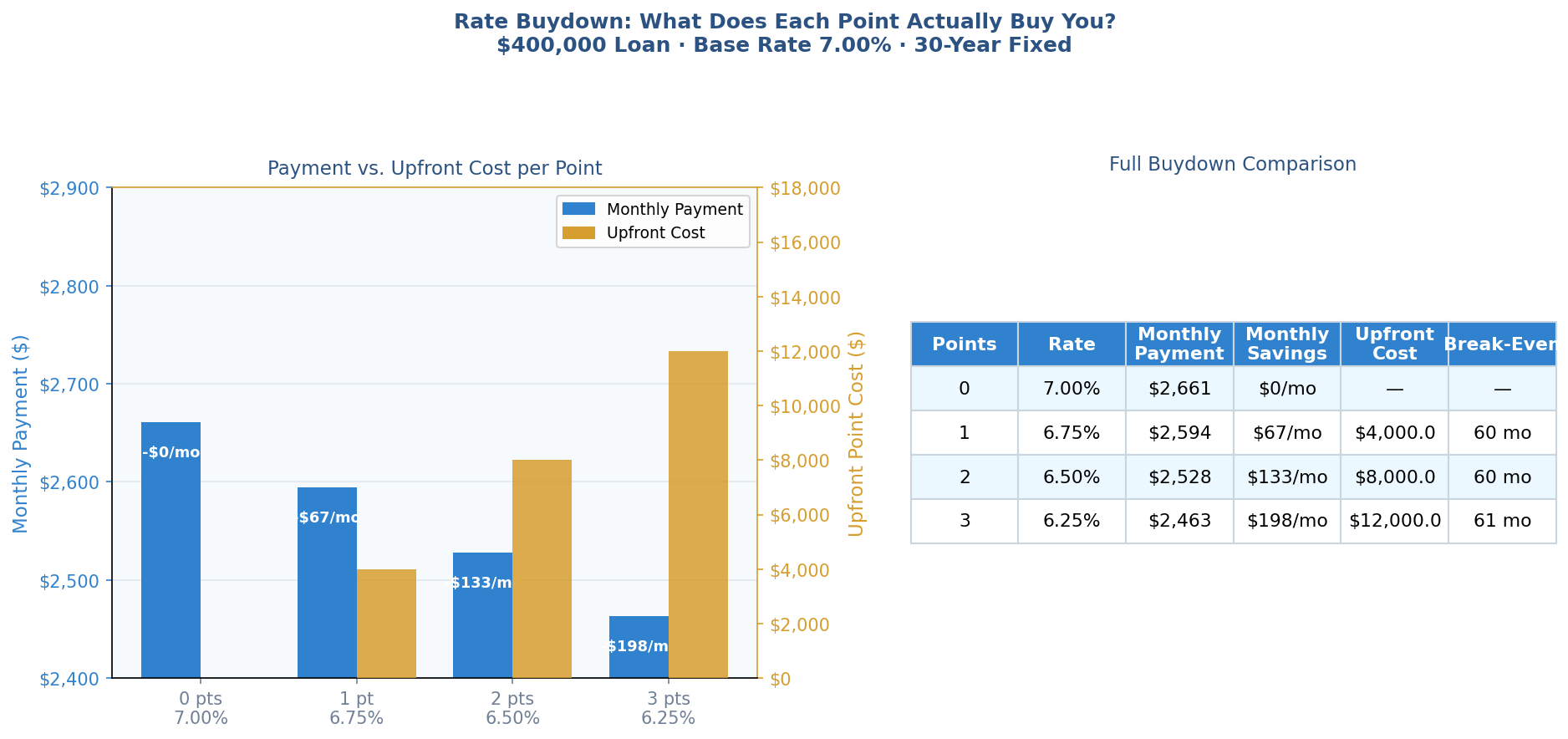
Think of it like prepaying your interest to secure a “discounted” rate for the duration of the mortgage. For every point you purchase—usually costing 1% of the total loan amount—your lender typically lowers your interest rate by a fraction of a percent (often 0.125% to 0.25%).
Ehrlich gesagt, the math can be a bit of a headache at first, but once you view it as an investment with a specific “break-even point,” it becomes a much clearer financial decision.
Why 2026 Is a Unique Time for Rate Buy-Downs
The economic climate of 2026 presents specific opportunities. While we’ve seen stabilization compared to the chaotic interest rate swings of the early 2020s, rates remain a significant factor in your monthly debt-to-income ratio.
For high-earning professionals, the goal isn’t just to get into a home; it’s to ensure that your monthly cash flow remains as lean and efficient as possible. Buying down the rate allows you to hedge against potential inflation or long-term interest rate stickiness. If you plan on staying in your home for seven years or more, this strategy often transitions from a “maybe” to a “must-consider.”
Step-by-Step: How to Execute a Rate Buy-Down
You shouldn’t just walk into a lender’s office and throw money at the wall hoping for a lower rate. You need a strategic approach. Here is how to navigate the process like a pro.
1. Assess Your Long-Term Housing Timeline
Before you pay a cent, ask yourself the honest question: How long do I intend to stay here? If you’re planning on moving in three years for a job relocation, buying points is almost certainly a bad financial move. You won’t live in the house long enough to “earn back” the money you spent upfront. But if this is your long-term primary residence, the math shifts in your favor.
2. Calculate Your “Break-Even” Point
This is exactly where most people get it wrong. You need to calculate how many months it will take for your monthly savings to cover the initial cost of the discount points.
- The Math: Take the total cost of the points and divide it by the monthly savings on your mortgage payment.
- The Result: If it takes 48 months to break even, and you know you’re staying for 10 years, you’re looking at six years of pure savings. That’s a solid return on investment.
3. Request a “Loan Estimate” with and without Points
Don’t just take the lender’s word for it. Ask for two separate Loan Estimates (LEs): one with points and one without. Put them side-by-side. You’ll be surprised how much clearer the choice becomes when you see the actual monthly payment difference versus the total cash-to-close difference.
4. Negotiate Seller Concessions
Here is a pro tip: You don’t always have to pay for these points yourself. In a 2026 market that is becoming increasingly balanced, sellers are often looking for ways to sweeten the deal to move a property quickly. You can ask for “seller concessions” to cover the cost of your discount points. It’s a win-win—they get their sale price, and you get your lower rate, effectively paid for by the seller.
The Pitfalls: Common Mistakes Professionals Make
Even the most analytical minds can fall into traps when closing on a house. Avoid these three common errors:
- Ignoring Liquidity Needs: You might have the cash to buy down the rate, but will that drain your emergency fund? If paying for points leaves you with zero reserves for immediate home repairs or other investments, don’t do it. Cash is king, especially when you’re a new homeowner.
- Assuming Rates Will Drop Quickly: Some buyers skip the buy-down because they “know” they’ll just refinance in 18 months when rates drop. That’s a gamble. If rates don’t drop, you’re stuck with a higher payment. Don’t base your financial strategy on a prediction; base it on the current reality.
- Failing to Consult a Tax Pro: In some cases, mortgage interest points can be tax-deductible. Depending on your tax bracket and your specific situation, this could actually make buying points even more attractive. Always check with your CPA before closing.
When Should You Avoid Buying Down the Rate?
There are definitely times when keeping your cash in your pocket is smarter than buying down a rate.
If you are a professional who expects your income to rise significantly, or if you prefer to invest your excess capital into a brokerage account where it might yield a higher return than the interest savings you’d get on your mortgage, then skip the points.
Also, if you are looking at a home that needs significant renovations, keep that cash for the “sweat equity.” A kitchen remodel is often a better long-term value booster than a slightly lower interest rate.
Frequently Asked Questions (FAQ)
Can I buy down my interest rate on an investment property?
Yes, but the costs are usually higher and the impact on the interest rate is often smaller compared to a primary residence. Lenders view investment properties as higher risk, so the “discount” you get for each point is usually less attractive.
Is there a limit to how many points I can buy?
Technically, no, but lenders have a “point of diminishing returns.” At a certain point, the rate reduction becomes so marginal that it makes no sense to keep paying for points. Your lender should be able to show you the efficiency curve for this.
If I refinance later, do I lose the money I spent on points?
Exactly. That money is gone. This is why you must be confident about your stay-in-home duration. If you spend $10,000 to buy down your rate and you refinance after two years, you’ve essentially lit that money on fire.
The Bottom Line
Buying down your interest rate in 2026 is a financial instrument—not a magic bullet. It’s a tool for people who have a clear plan, a stable outlook on their living situation, and a desire to optimize their monthly cash flow.
When you approach it with the same level of due diligence that you bring to your professional work, it becomes just another smart financial move in your portfolio. Take the time to run your numbers, compare the scenarios, and don’t be afraid to ask for seller contributions. At the end of the day, you’re not just buying a house; you’re managing a major asset. Make it work for you.
📖 Complete guide: Mortgage Rates: Complete 2026 Guide
Related: 2026 Mortgage Points Calculator: The Ultimate Strategy Guide · Mastering Seller Concessions for Mortgages: A 2026 Guide · Down Payment Assistance 2026: A Professional Guide for Buyers · How to Buy a House With No Money Down A Strategic Guide