The landscape of residential real estate has shifted significantly over the last few years, and 2026 is proving to be a year of nuanced negotiations. If you’re a real estate professional, a loan officer, or a seasoned investor, you know that the term “seller concessions” carries more weight today than it did in the hyper-competitive markets of the early 2020s.
Gone are the days when simply offering the asking price was enough to secure a property. Today, the conversation is shifting toward value preservation and closing efficiency. Understanding how to leverage seller concessions for mortgages in 2026 isn’t just a technical skill—it’s an art form. Let’s dive into how you can use these tools to close deals, help your clients, and navigate the current regulatory environment with confidence.
What Exactly Are Seller Concessions?
At its core, a seller concession—or seller contribution—is an agreement where the seller pays for a portion of the buyer’s closing costs. Think of it as a tactical move to bridge the gap between a buyer’s liquid cash and the total cost of acquisition.
In 2026, we aren’t just talking about basic prepaid items. We’re seeing a shift toward “rate buydowns” (the famous 2-1 buydown still makes an appearance) and structural credit improvements. But here’s the catch: it’s not a blank check. Every loan program, whether it’s FHA, VA, or a Conventional mortgage, has a strict “cap” on how much a seller can contribute. If you cross that line, the lender has to pull that money back, which—let’s be honest—is the quickest way to kill a deal at the eleventh hour.
The 2026 Regulatory Landscape: What You Need to Know
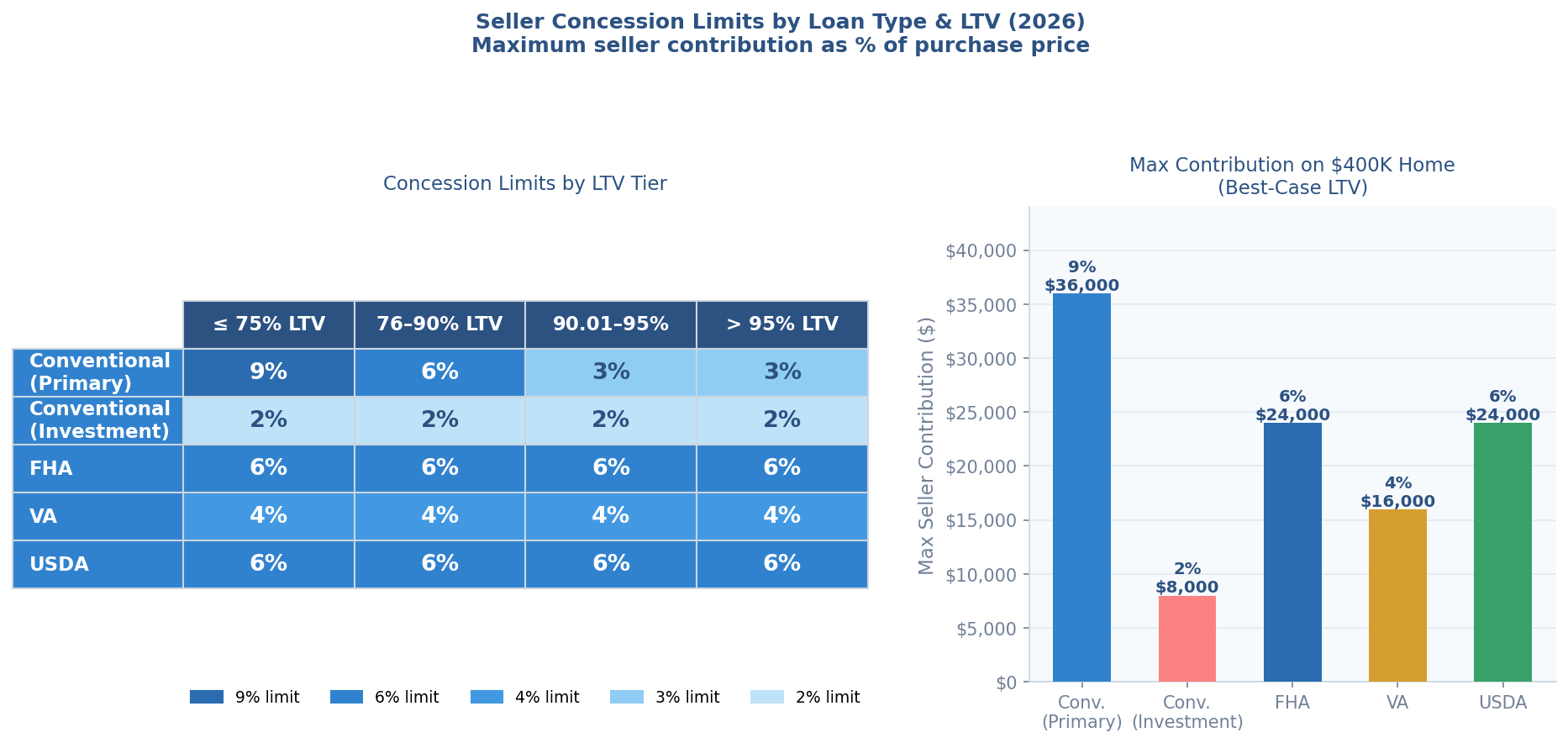
The rules governing concessions remain anchored in the “LTV” (Loan-to-Value) and “Occupancy Type” framework. In 2026, lenders are under higher scrutiny regarding “interested party contributions.”
The Standard Caps (Keep These Handy):
- Conventional Loans:
- 90% LTV or less: 6% of the purchase price.
- 90.01% – 95% LTV: 3% of the purchase price.
- 95%+ LTV: 2% of the purchase price.
- Investment Properties: 2% across the board (strictly enforced).
- FHA Loans: Fixed at 6% of the purchase price.
- VA Loans: Allows up to 4% in concessions, but here’s a pro tip: “discount points” and certain other fees often fall outside this 4% cap, which gives you more breathing room than you think.
Knowing these numbers by heart isn’t just for show; it’s about providing quick, actionable advice when your client is staring at a contract draft in a coffee shop.
Step-by-Step: How to Negotiate Concessions in 2026
Negotiating these concessions requires a blend of empathy and data. You aren’t asking for a handout; you’re proposing a solution that gets the seller to their “net” goal while easing the buyer’s burden.
Step 1: The Pre-Offer Audit
Before you even draft the contract, look at the property’s “Days on Market” (DOM). If a house has been sitting for 30 days in this 2026 market, the seller is likely feeling the pressure. That’s your leverage point. Don’t just look at the price; look at the listing agent’s pain points.
Step 2: Calculate the “Net-Net”
Sellers care about one thing: the net proceeds. If you ask for $10,000 in concessions but offer $5,000 over the asking price, the seller’s net hasn’t actually changed. This is the secret language of successful negotiation. Present the concession as a way to “smooth out the path to closing” rather than a deduction from their profit.
Step 3: Align with the Loan Officer
Ehrlicher gesagt, viele Deals scheitern, weil der Käufer-Agent und der Loan Officer nicht auf demselben Stand sind. Call your loan officer before the offer goes out. Ask: “If we ask for 3% in concessions, does that hit our cap?” You don’t want to find out during underwriting that you’ve requested 4% on a 97% LTV loan. That’s a rookie mistake.
Step 4: The “Value-Add” Justification
If the appraisal comes in slightly low, don’t panic. Use the seller concession as a tool to cover the appraisal gap. It’s a clean way to keep the deal alive without forcing the buyer to cough up more cash for a down payment they may not have.
Common Pitfalls: Where Even the Best Go Wrong
We’ve all seen it: a deal is humming along, and then suddenly, a “concession error” pops up. It’s like a pebble in a shoe—annoying, but it can stop you dead in your tracks.
1. The “Excessive Contribution” Trap
If the total concessions exceed the allowable closing costs, that money effectively becomes a price reduction. This isn’t always bad, but it forces the lender to re-run the numbers, which delays the Closing Disclosure (CD). In 2026, speed is everything. Don’t let a math error trigger a three-day waiting period restart.
2. Confusing Personal Property with Closing Costs
Don’t get cute by offering to buy the seller’s furniture and calling it a “closing cost credit.” Lenders see right through that. Any credit must be documented, legitimate, and applied strictly to prepaid items, taxes, or prepaids. Keep it clean, keep it documented.
3. Ignoring the “Appraisal-Concession” Relationship
Sometimes, sellers think that by giving a concession, they are “paying” for the low appraisal. They aren’t. An appraisal is about the property value; a concession is about the transaction costs. Ensure your sellers understand the distinction so they don’t feel “double-charged” if they have to drop the price and provide credit.
The 2026 Market Outlook: Why Concessions Are Your Best Friend
We are seeing a trend in 2026 where buyers are wary of interest rate volatility. By negotiating seller concessions to cover a 1-0 or 2-1 buydown, you aren’t just helping them close; you’re helping them manage their monthly debt-to-income ratio (DTI).
Think of it as a bridge. You’re giving the buyer the ability to enter the home at a comfortable payment level while giving the seller a faster, more reliable closing. It’s a win-win, provided you frame it that way.
Pro Tips for the Modern Professional
- The “Net Sheet” is your Bible: Always provide a net sheet to the listing agent showing exactly what they walk away with after your requested concessions. Visuals win negotiations.
- Be Transparent with the Lender: If you’re pushing the limit on concessions, tell the loan officer early. They can structure the loan to ensure it passes automated underwriting systems (AUS).
- Don’t Over-Ask: If the seller is already being aggressive on the list price, asking for the max concession might come across as tone-deaf. Read the room.
Final Thoughts: The Human Element
At the end of the day, negotiation isn’t about crushing the other side; it’s about finding the point where both parties feel like they’ve won. Seller concessions in 2026 are simply a tool to help people move forward—whether that’s a family getting into their first home or a seller downsizing for retirement.
Stay sharp, keep your numbers clear, and remember: you aren’t just managing a transaction; you’re managing the emotions that come with one of the biggest life decisions your client will ever make. Use these concessions wisely, and you’ll find that your closing rate—and your reputation—will reflect the expertise you bring to the table.
📖 Complete guide: Mortgage Rates: Complete 2026 Guide
📖 Complete guide: First-Time Home Buyer Guide 2026
Related: 2026 Mortgage Points Calculator: The Ultimate Strategy Guide · How to Buy Down Your Interest Rate in 2026: A Pro Guide · Down Payment Assistance 2026: A Professional Guide for Buyers · How to Buy a House With No Money Down A Strategic Guide