For most professionals, the dream of homeownership often hits a brick wall at the same spot: the down payment. We’ve been conditioned to believe that you need a hefty 20% lump sum sitting in a high-yield savings account before you even think about calling a realtor.
But here is the reality check: That “20% rule” is becoming a relic of the past.
Can you buy a house with no money down? The short answer is yes. But the “how” requires more than just a search for low-interest rates—it requires a strategic approach to your personal finances and an understanding of the specific programs available to you. Let’s pull back the curtain on how to navigate this path without feeling like you’re walking a tightrope.
Why the “20% Down” Myth Needs to Die
Honestly, if we all waited until we had 20% of a home’s purchase price in cash, the majority of us would be renting well into our mid-forties. In many markets, that represents a six-figure sum. It’s a massive amount of capital to tie up in a single asset, especially when you consider that your money could be working harder for you elsewhere—like in diversified investments or retirement accounts.
The beauty of modern lending is that there are pathways designed specifically to lower the barrier to entry. While “no money down” sounds like a marketing gimmick, it is a legitimate financial strategy used by savvy buyers every single day.
The Primary Avenues for Zero-Down Financing
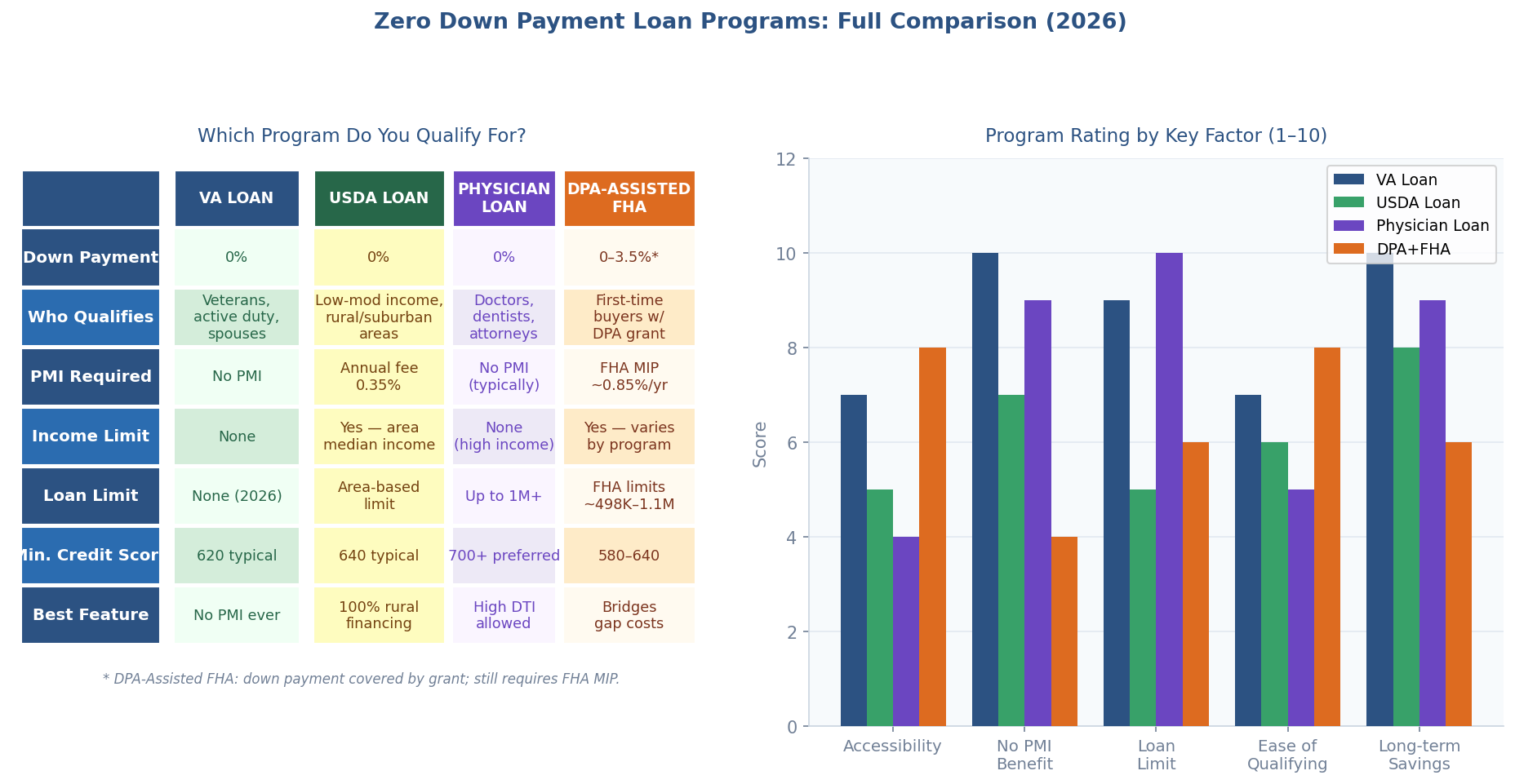
If you’re looking to step onto the property ladder without a massive cash outlay, there are three primary pillars you need to understand.
1. The VA Loan: The Gold Standard
If you are a veteran, active-duty service member, or a surviving spouse, the VA loan is arguably the best mortgage product in existence.
- The Benefit: No down payment is required, and there is no monthly private mortgage insurance (PMI).
- The Nuance: Because the government guarantees a portion of the loan, lenders can be incredibly competitive. It’s a thank-you from the system, and if you’re eligible, you shouldn’t look anywhere else.
2. The USDA Rural Development Loan
Many people hear “rural” and assume it means living in a remote cabin hours from civilization. That’s a common misconception.
- The Reality: The USDA defines “rural” surprisingly broadly. Many suburban areas on the outskirts of major cities qualify.
- The Strategy: These loans are income-restricted, but if you fall within the guidelines, you can secure 100% financing. It’s worth checking the USDA eligibility map—you might be surprised to find your target neighborhood qualifies.
3. Physician Loans and Professional Mortgages
If you are a doctor, dentist, attorney, or sometimes even a high-earning corporate professional, lenders often offer “niche” loans.
- Why they do it: Banks know that while you might be short on liquid cash today, your future earning potential is a stable bet. They want your business, so they waive the down payment requirements—even on high-balance loans—in exchange for a slightly higher interest rate or a specific banking relationship.
Step-by-Step: How to Position Yourself for Approval
Buying a home with no money down isn’t just about finding the right loan; it’s about proving to the bank that you are a low-risk borrower. Think of it like pitching a business case: you are the business, and your credit score is your track record.
Step 1: Audit Your Credit Profile
Before you even talk to a lender, pull your credit reports. Look for errors. A single missed utility payment from three years ago can drop your score enough to disqualify you from specific zero-down programs. You want your score as close to 720+ as possible. Why? Because while some programs accept lower scores, the best interest rates (which save you thousands over time) are reserved for those with “excellent” ratings.
Step 2: Manage Your Debt-to-Income (DTI) Ratio
Lenders care about your cash flow. If you have a car payment, a massive student loan, and high credit card balances, your DTI will be too high.
- Pro Tip: Try to pay down high-interest credit cards at least six months before you apply. It’s exactly the kind of move that signals to a lender that you’re fiscally responsible.
Step 3: Get Pre-Approved, Not Just Pre-Qualified
There is a massive difference here. A pre-qualification is a back-of-the-napkin estimate. A pre-approval means a human underwriter has actually looked at your tax returns, W-2s, and bank statements. In a competitive market, a seller will choose an offer from someone with a solid pre-approval every single time.
Common Pitfalls: Where Buyers Trip Up
Even with the best intentions, the process has landmines. Here is how to keep your footing.
Falling for the “Budget Trap”
Just because you can borrow the money doesn’t mean you should borrow the maximum amount. If the bank says you are approved for $500k, calculate your monthly payment on that amount including taxes and insurance. Does it still feel comfortable? If you feel stressed just looking at the number, look for a $425k house instead. Your quality of life matters more than your square footage.
The “No Down Payment” Isn’t “No Costs”
This is the most common point of confusion. Zero down does not mean zero cash to close. You still have to pay for:
- Home inspections (Do not skip this, ever!)
- Appraisal fees
- Title insurance
- Closing costs (Lawyers, local taxes, etc.)
Expect to have at least 2% to 3% of the home’s price in liquid savings to cover these transaction costs. If you don’t have it, ask your realtor about “seller concessions,” where you negotiate for the seller to cover some of your closing costs.
Ignoring Private Mortgage Insurance (PMI)
If you aren’t using a VA loan, a zero-down loan often comes with PMI. This is a monthly fee that protects the lender, not you. It adds to your monthly mortgage payment. Factor this into your budget early so you aren’t shocked when the final paperwork arrives.
Frequently Asked Questions
“Do I need to be a first-time homebuyer to get no-money-down deals?” Generally, no. VA loans and many professional mortgages are available even if you’ve owned a home previously. USDA loans have stricter rules, but it’s always worth checking the fine print.
“Is it better to wait and save for a down payment?” It’s a trade-off. If you save, you have more equity, a lower monthly payment, and no PMI. But if the market keeps rising while you save, you might end up “priced out.” There is no right answer—only what works for your current risk tolerance and financial goals.
“How do I find a lender who knows these niche programs?” Don’t just walk into the nearest retail bank. Look for local mortgage brokers. They act as independent advocates and have access to a much wider array of loan products than a single big-name bank.
Final Thoughts: The Path Forward
Buying a house with no money down is a legitimate strategy, but it requires being an informed buyer. You aren’t just looking for a roof over your head; you are looking for a financial vehicle that fits your lifestyle.
Don’t let the noise of the real estate market overwhelm you. Take it one step at a time: clear up your credit, talk to a broker who specializes in your specific situation (like a VA or professional loan expert), and always keep an eye on your long-term monthly budget.
You’ve got this. The goal isn’t just to buy a house—it’s to buy a house that leaves you enough room to actually enjoy living in it.
📖 Complete guide: First-Time Home Buyer Guide 2026
Related: Down Payment Assistance 2026: A Professional Guide for Buyers · How Much Down Payment Do You Really Need for a Home? · Down Payment Assistance: A Roadmap for First-Time Home Buyers · Closing Costs 2026 Estimate: A Professional Guide for Buyers