Buying or refinancing property in 2026 feels a bit like navigating a ship through shifting tides. If you’ve been through the process before, you know that the actual price tag is rarely just the purchase price or the loan amount. There’s that looming, often complex beast known as “closing costs.”
For professionals—whether you’re an investor scaling your portfolio or a high-net-worth individual securing a primary residence—surprises at the closing table are more than just an annoyance; they’re a disruption to your financial strategy.
In this guide, we’re going to break down exactly how to create an accurate closing costs 2026 estimate, strip away the industry jargon, and ensure you head to the closing table with eyes wide open.
What Actually Goes Into Closing Costs?
Before we look at the numbers for 2026, let’s clear the air. Closing costs aren’t a singular fee. They are a collection of individual charges paid to third parties—lenders, title companies, government agencies, and inspectors—to move the transaction across the finish line.
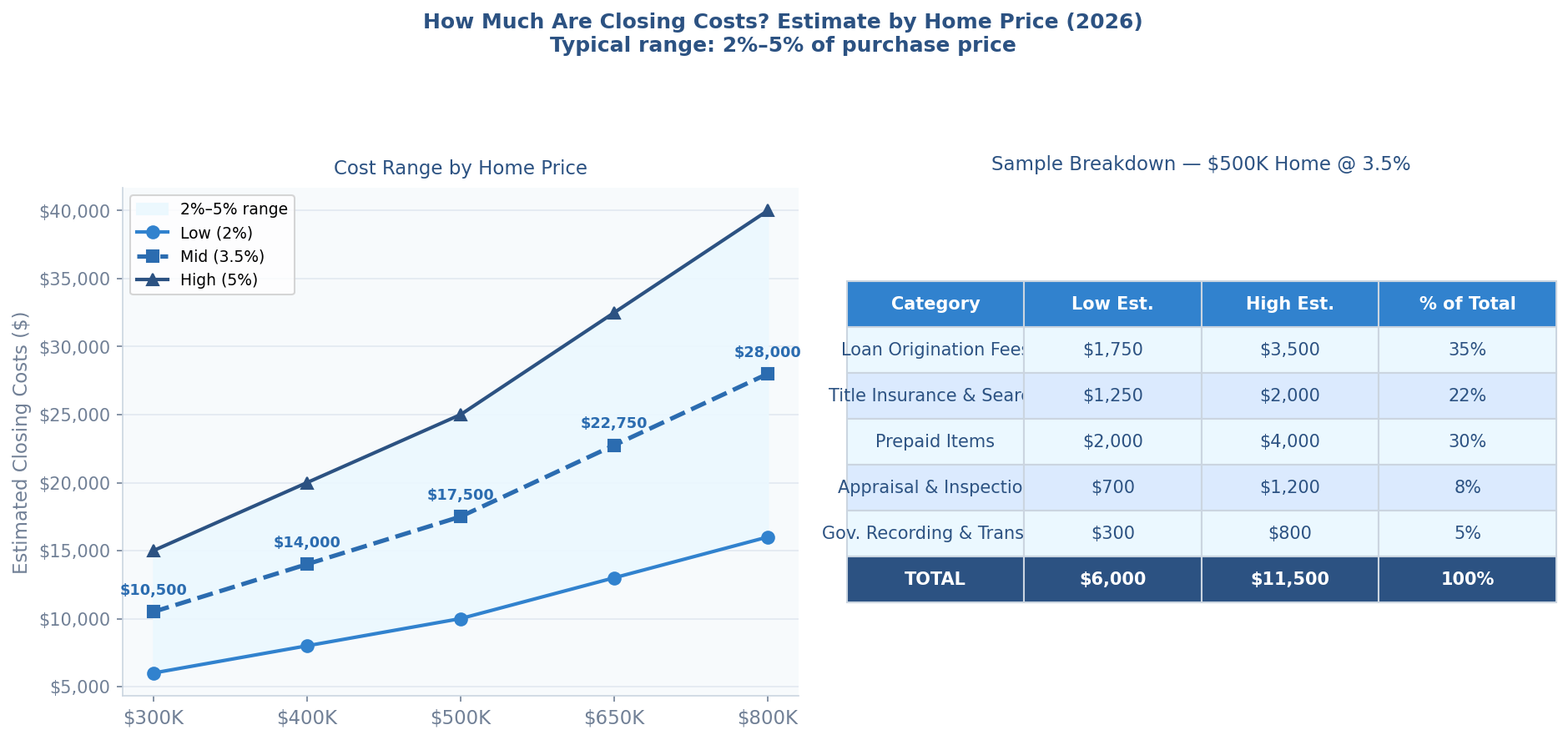
Typically, you can expect these costs to range between 2% and 5% of your total loan amount. If you’re buying a $800,000 home, that’s a swing of $16,000 to $40,000. That’s not “rounding error” money; that’s capital you could be deploying elsewhere.
The Breakdown of Costs
- Loan Origination Fees: The cost of the lender actually processing your loan.
- Appraisal & Inspection Fees: Necessary to verify the value and condition of the asset.
- Title Insurance & Search: To ensure no one else has a “claim” on your property.
- Prepaid Items: Property taxes, homeowners insurance, and interest that needs to be paid upfront.
- Government Recording Fees: The cost of filing the deed with the county.
Step-by-Step: How to Calculate Your 2026 Estimate
If you want an accurate forecast rather than a vague guess, you need a systematic approach. Here is how you build your own estimate.
Step 1: Secure a Loan Estimate (LE)
Never rely on a napkin calculation. Once you provide a lender with your financial details, they are legally required to provide a Loan Estimate within three business days. Honestly, this is your gold standard document. It’s standardized across the industry, making it easy to compare lenders side-by-side.
Step 2: Factor in the “Geographic Multiplier”
This is where many people trip up. Closing costs are heavily location-dependent. A home in a high-tax state or a city with complex transfer tax regulations will have vastly different costs than a property in a rural county. Research the specific “Transfer Taxes” or “Mortgage Recording Taxes” for your municipality.
Step 3: Audit the Prepaid Items
Lenders often pad their estimates for property taxes and insurance to be “safe.” While that’s fine for the bank, it’s bad for your cash flow. Ask them: “Are these figures based on last year’s tax assessment or current projections?” Knowing the difference helps you keep more liquidity in your pocket.
Step 4: The “Buffer” Rule
As a professional, you know that unexpected contingencies happen. Always add a 10-15% “cushion” to your total estimate. If the closing statement comes in lower, great—you’ve just saved cash. If it comes in higher, you’ve already accounted for it in your liquidity plan.
Common Pitfalls: Where Professionals Get Caught
You’d think experienced buyers would be immune to closing day surprises, but you’d be surprised. Even seasoned investors sometimes skip the basics.
1. The “Title Insurance” Trap
Many buyers assume the title insurance fee is non-negotiable. While the base rate is often set by the state, you can sometimes shop for “closing services” or “settlement fees” through different title companies. Don’t be afraid to ask for an itemized list of what they’re charging for courier fees, wire fees, and document prep. Sometimes, these are inflated “junk fees.”
2. Ignoring Escrow Shortfalls
If you are closing on a property at a specific time of year, your escrow account setup might be heavier than expected. If you’re closing right before property taxes are due, the lender will require you to fund that escrow account immediately. Always check the calendar.
3. Last-Minute Rate Locks
If your interest rate fluctuates right before closing, your prepaid interest will shift, too. It’s a small, technical detail, but it’s exactly the kind of thing that makes a “final” closing statement look different from the one you reviewed two days prior.
Strategic Tips for 2026 Market Conditions
The 2026 market carries its own set of nuances. With evolving digital notary laws and faster, automated underwriting, some costs are actually decreasing. However, regulatory compliance fees are rising.
- Go Digital: If your state allows for Remote Online Notarization (RON), take it. It usually shaves off a few hundred dollars in travel and courier fees.
- Negotiate Seller Concessions: In many markets, it is still acceptable to ask the seller to contribute to your closing costs. Even if you don’t need the help, using the seller’s money to cover these fees preserves your own capital for renovations or investment opportunities.
- Ask for the “Closing Disclosure” (CD) Early: Your lender is required to provide the Closing Disclosure at least three business days before closing. Do not wait until the final hour to review it. Sit down with it, compare it to your original Loan Estimate, and demand an explanation for any fee that increased by more than 10%.
Frequently Asked Questions
Is it possible to roll closing costs into the loan?
Generally, no. Closing costs are typically paid out-of-pocket at the closing table. Some loan programs allow for “lender credits,” where you take a slightly higher interest rate in exchange for the lender covering a portion of your costs. It’s a trade-off—lower upfront cash versus higher monthly payments.
Are closing costs tax-deductible?
For a primary residence, most closing costs are not tax-deductible. However, if you are purchasing an investment property, many of these costs can be capitalized and amortized over the life of the loan. Always consult your CPA before tax season.
Why do estimates differ between lenders?
One lender might be conservative with their escrow estimates, while another might be aggressive to make their initial quote look “cheaper.” This is exactly why you need to look at the APR (Annual Percentage Rate) and the total cash-to-close on the Loan Estimate, not just the interest rate.
Final Thoughts: The Professional Mindset
Managing your closing costs 2026 estimate isn’t about penny-pinching—it’s about precision. When you view your transaction through a professional lens, you stop being a passive participant and start becoming an active manager of your capital.
Keep your documents organized, stay curious about every line item on that disclosure, and never settle for a “just trust me” from a title rep or loan officer. When you’ve done your homework, closing day isn’t a high-stress event full of financial surprises—it’s simply the final, satisfying checkmark on a well-executed plan.
You’ve got this. Just stay meticulous, keep your buffer ready, and move forward with confidence.
📖 Complete guide: First-Time Home Buyer Guide 2026
Related: Closing Costs Explained: A Guide for Savvy Homebuyers · Appraisal vs. Inspection 2026: A Guide for Real Estate Pros · Down Payment Assistance 2026: A Professional Guide for Buyers · How to Buy a House With No Money Down A Strategic Guide