You’ve finally found the home of your dreams. The negotiations are over, the inspections are behind you, and you’re just a few signatures away from holding those keys. Then, the “Closing Disclosure” lands in your inbox.
If you’ve ever felt that sudden, sinking pit in your stomach when looking at that final bottom-line number, you aren’t alone. For many professionals, the home-buying process is a masterclass in financial endurance. We often focus so intently on the down payment and the monthly mortgage rate that we treat “closing costs” as an afterthought. But here is the reality: closing costs are essentially the “hidden engine” of the real estate transaction. Ignoring them is like preparing for a marathon but forgetting to buy running shoes.
In this guide, we’re going to pull back the curtain on these fees. We’ll break down exactly what you’re paying for, why these costs exist, and—crucially—how you can navigate them without losing your cool.
What Exactly Are Closing Costs?
At their simplest, closing costs are the bundle of fees, taxes, and service charges you pay to finalize a real estate transaction. Think of it this way: buying a house isn’t just about the money changing hands for the property itself; it’s a legal and administrative choreography involving title companies, government agencies, lenders, and appraisers. Everyone needs to be compensated for their role in moving the property from the seller’s name to yours.
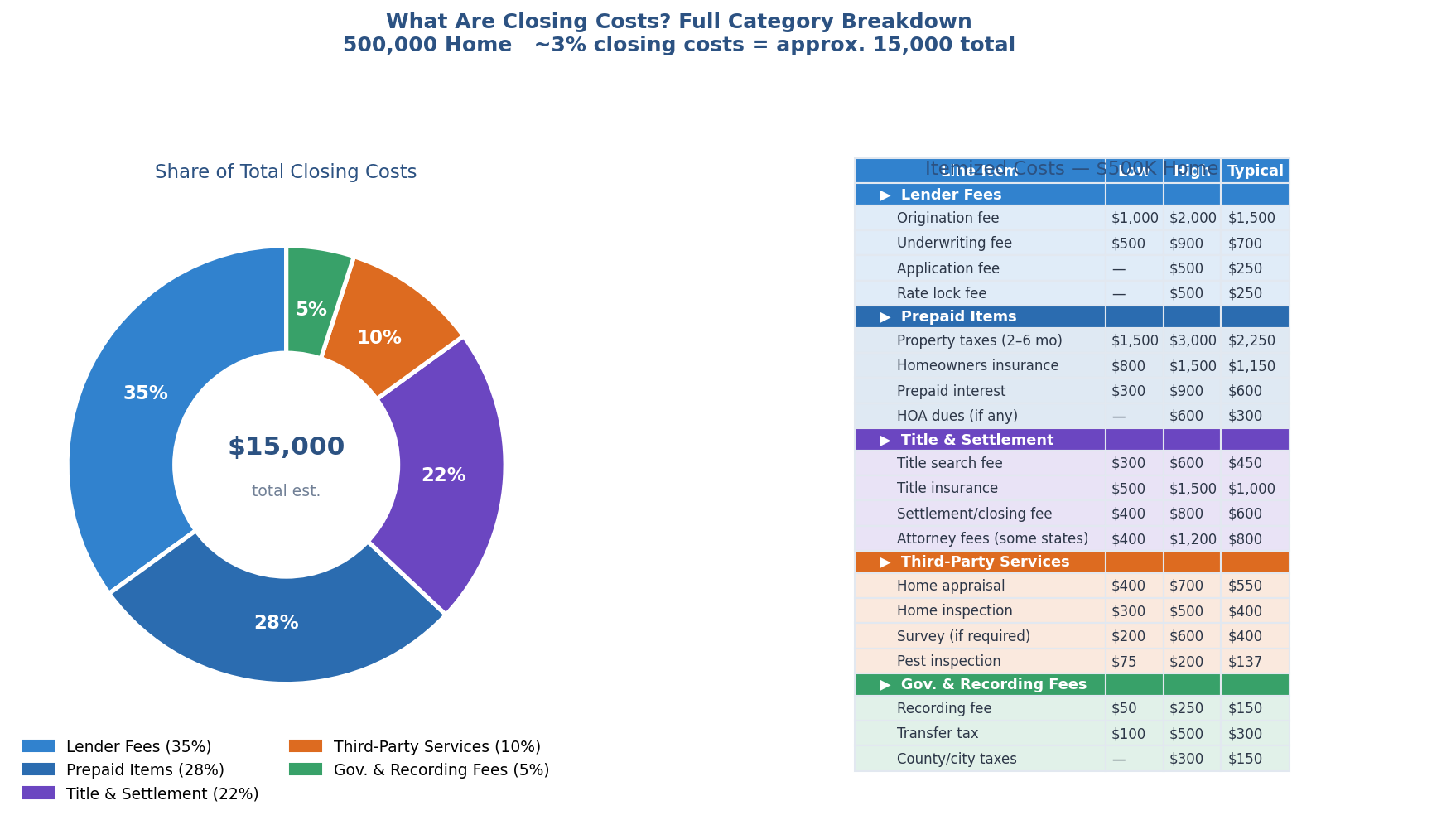
These costs typically range from 2% to 5% of the total loan amount. If you are buying a $500,000 home, that could mean an extra $10,000 to $25,000 coming out of your pocket on closing day. Yes, it’s a significant chunk of change—which is exactly why we need to talk about it now, rather than three days before you sign the deed.
The Breakdown: What’s Actually on the Bill?
Closing costs are rarely just one line item. They are a mosaic of smaller fees. To make sense of them, let’s categorize them into the four buckets that most professionals encounter.
1. Loan-Related Fees
These are the costs your lender charges to process and “originate” your mortgage.
- Application Fee: The administrative cost to process your initial request.
- Origination Fee: Often the biggest item here. This covers the lender’s work in evaluating, preparing, and submitting your loan.
- Underwriting Fee: This covers the cost of the experts who verify your financial data and decide whether you represent a “safe” risk.
2. Third-Party Service Fees
You aren’t just paying the bank; you’re paying for the specialized work required to prove you actually own the home free and clear.
- Appraisal Fee: A third party must confirm that the house is worth what you’re paying for it. If the appraisal comes in low, the lender won’t fund the loan. It’s an essential safety net, albeit a mandatory expense.
- Title Search and Insurance: This is non-negotiable. You need a professional to scour public records to ensure no one else has a legal claim to the property. Title insurance protects you against any “ghosts” from the property’s past—like an unpaid lien from a contractor five years ago.
3. Government and Legal Fees
Bureaucracy isn’t free. You will see charges for recording the deed with the county and, in some jurisdictions, transfer taxes. These are fixed costs that vary wildly depending on your zip code.
4. Prepaid Items (The “Escrow” Bucket)
This is where people get confused. These aren’t really costs of buying the house; they are payments you are making in advance.
- Property Taxes: Lenders usually want a few months of taxes held in an escrow account.
- Homeowners Insurance: You’ll likely pay your first year of premiums upfront.
- Prepaid Interest: Interest on your mortgage accrues daily. You’ll pay the interest that accumulates between your closing date and the end of that month.
Step-by-Step: Managing Your Closing Costs
You’re a busy professional. You don’t have time for a last-minute scramble. Here is your game plan to ensure you aren’t blindsided at the closing table.
Step 1: Demand the “Loan Estimate” Early
Within three business days of submitting your mortgage application, your lender is legally required to send you a Loan Estimate (LE). Please, do yourself a favor: read it. Don’t just look at the monthly payment figure. Look at the “Closing Cost Details” section. If there is a fee you don’t understand, call your loan officer immediately.
Step 2: Shop Around for Third-Party Services
Many homebuyers don’t realize that they have the right to compare prices for some services. For example, you might be able to find a more cost-effective title insurance company than the one the lender initially suggests. Ask your lender: “Which of these services am I allowed to shop for?” You could save hundreds, maybe even a thousand dollars, with a few targeted emails.
Step 3: Compare the Loan Estimate to the “Closing Disclosure”
Three days before you sign, you will receive the Closing Disclosure (CD). This is the final draft of your costs. Compare this line-by-line with your original Loan Estimate. If you see a number that has jumped significantly—a “fee creep”—ask why. Honest lenders will have a legitimate explanation (e.g., an adjustment in taxes); shady ones will try to hide errors. Stay sharp.
Common Pitfalls (And How to Avoid Them)
We’ve seen it happen. Even seasoned investors make mistakes here. Avoid these three common traps:
- The “Cash-to-Close” Blindspot: Many people move their money into high-yield savings or investment accounts thinking they have the cash, only to realize the money is tied up for a few days. Pro tip: Keep your closing funds in a highly liquid account at least two weeks before your closing date. Do not move money around right before closing; it creates a “paper trail” nightmare for your underwriter.
- Assuming All Fees are Fixed: Some fees are non-negotiable, but others—like certain administrative processing fees—are sometimes flexible if you negotiate early. Don’t be afraid to ask, “Is this fee standard, or can we waive this?” The worst they can say is no.
- Ignoring the “Gift” Rules: Planning to have a family member help with these costs? Be careful. Lenders have strict rules about “gift funds.” If you don’t document this according to their specific requirements, it could derail your entire loan approval.
Can You Avoid These Costs?
Ehrlich gesagt: You can’t avoid them entirely. Someone has to pay for the title search, and the government will always want their taxes. However, you can shift the burden.
- Seller Concessions: In a buyer’s market, you can negotiate for the seller to cover a portion of your closing costs. This is a common tactic, but be aware that it might affect your purchase price offer.
- Lender Credits: Some lenders offer “no-closing-cost” loans. Be wary, though—these are rarely “free.” Usually, the lender charges a slightly higher interest rate to cover the costs you’re avoiding. If you plan to stay in the home for 10+ years, paying the closing costs upfront is usually mathematically superior to taking the higher interest rate.
The Big Picture: Why It Matters
Understanding your closing costs is about more than just avoiding a headache on closing day; it’s about financial empowerment. When you know where every dollar is going, you shift from being a passive participant in your own mortgage process to an active strategist.
You’re about to make one of the biggest purchases of your life. It deserves the same analytical rigor you apply to your professional projects. By prepping early, auditing your documents, and asking the hard questions, you’ll walk into that closing room with total confidence.
And when you finally get the keys? You can pop the champagne knowing that you didn’t just buy a house—you navigated the system like a pro.
Quick Summary Checklist for Closing Day:
- Review your Closing Disclosure (CD) against the Loan Estimate (LE).
- Verify the funds are in your bank account (liquid and ready).
- Confirm with your title company on the method of payment (most now require wire transfers—be vigilant against wire fraud!).
- Bring your photo ID and any requested documents.
- Don’t hesitate to ask questions at the table. If you don’t understand a fee, ask before you sign.
You’ve got this. Happy homebuying.
📖 Complete guide: First-Time Home Buyer Guide 2026
Related: Closing Costs 2026 Estimate: A Professional Guide for Buyers · Appraisal vs. Inspection 2026: A Guide for Real Estate Pros · Down Payment Assistance 2026: A Professional Guide for Buyers · How to Buy a House With No Money Down A Strategic Guide