Navigating the mortgage landscape in 2026 feels a bit like trying to solve a puzzle where some of the pieces are still being cut. If you’re a professional—perhaps you’re balancing a portfolio, managing personal equity, or simply planning your next real estate move—you’ve likely stumbled upon the concept of “mortgage points” (or discount points) more than once.
But here is the truth: Most people look at those numbers, shrug, and hope for the best. That’s a mistake. Using a mortgage points calculator 2026 isn’t just about crunching numbers; it’s about deciding whether you want to pay more now to breathe easier later. Let’s break this down, step-by-step, without the financial jargon headache.
What Exactly Are Mortgage Points? (A Quick Refresher)
Before we dive into the math, let’s get the terminology straight. Mortgage points are essentially prepaid interest. You’re paying the lender a fee upfront at closing in exchange for a lower interest rate over the life of your loan. One point usually equals 1% of your total loan amount.
It sounds simple, right? “I pay $5,000 now, my rate drops by 0.25%, and I save money.” But is it actually a good deal? That’s where the 2026 mortgage points calculator becomes your best friend.
Step 1: Gather Your Data Before You Calculate
You can’t get an accurate output if you’re putting in guesswork. Before you open a calculator, grab these four documents:
- Your Loan Amount: Be precise. Don’t estimate.
- Current Interest Rate Quote: Your lender should provide a “par rate” (the rate without any points) and the cost of points.
- Your Estimated Tenure: This is the most crucial part that people ignore. How long do you really plan to stay in the home?
- Closing Costs Budget: Can you afford to add points to your closing bill, or will that strain your liquidity?
Pro-tip: If you’re planning on moving in four years, paying for points that take seven years to “break even” is just burning cash. Be honest with your timeline.
Step 2: Inputting Your Variables into the 2026 Calculator
When you use a 2026 mortgage points calculator, the interface will ask for specific inputs. Here’s what you need to watch for:
- The Point Cost: Ensure this reflects the current market fees. In 2026, lenders are adjusting these frequently based on volatility.
- The Rate Reduction: Look at how much the rate actually drops per point. If the reduction is marginal, walk away.
- Loan Term: Whether you are looking at a 15-year or 30-year fixed, the impact of points changes significantly.
Common Pitfall: Many people forget to account for the “Opportunity Cost.” If you pay $10,000 in points, that’s $10,000 you aren’t investing elsewhere. A good calculator should allow you to compare the ROI of paying points versus investing that same sum in an index fund or savings vehicle.
Step 3: Analyzing the “Break-Even Point”
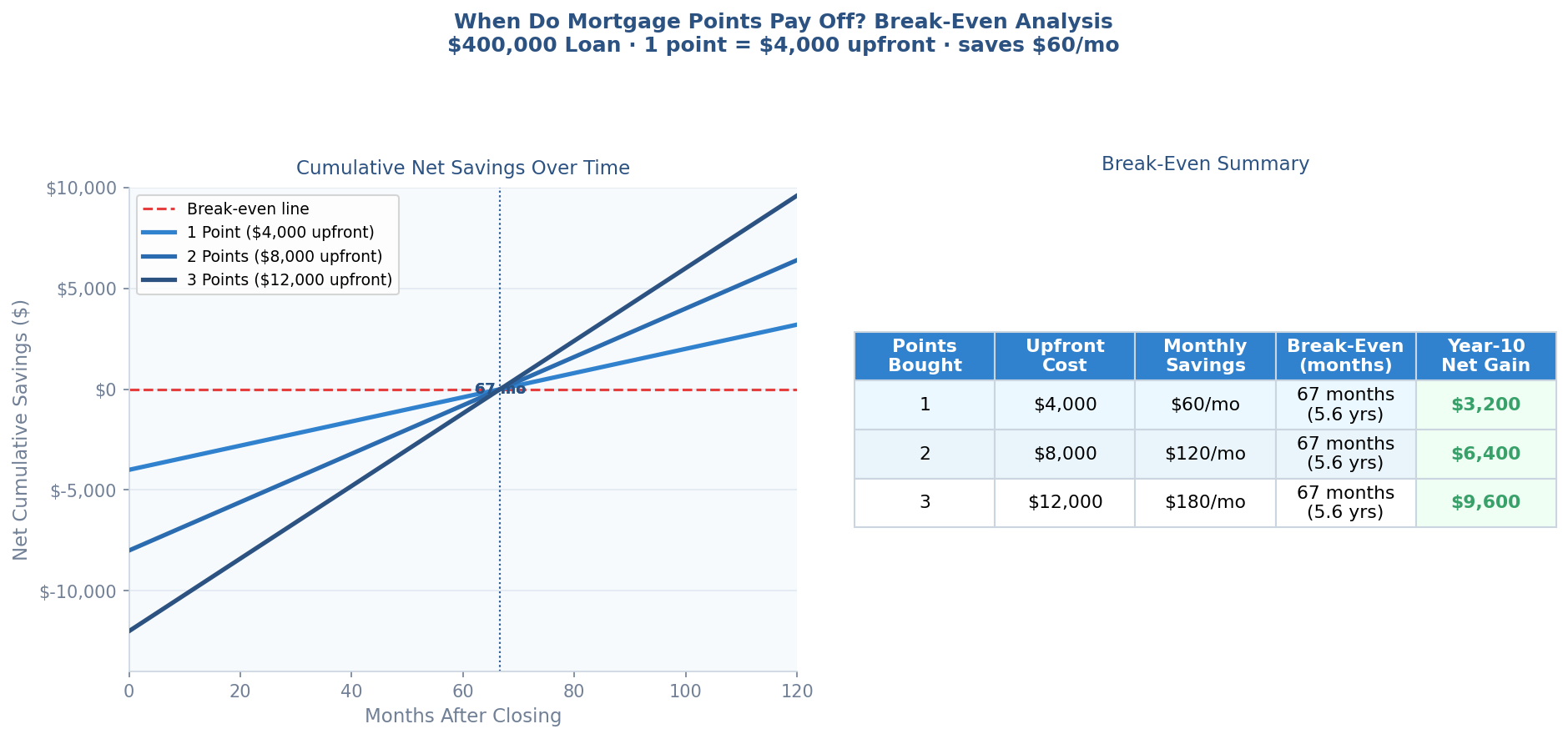
This is where the magic—or the reality check—happens. The break-even point is the exact month where your monthly interest savings pay off the upfront cost of the points.
The Math (Simplified): If buying one point costs $4,000 and saves you $60 a month in interest: $4,000 / $60 = 66.6 months (roughly 5.5 years).
If you plan to sell or refinance in year four, you’ve effectively lost money. It’s a simple concept, but you’d be surprised how many professionals skip this check because they’re focused on the “lower interest rate” marketing lure.
Common Pitfalls to Avoid in 2026
I’ve seen many smart people make rookie mistakes with points. Let’s avoid those:
1. The “Refinance Trap”
You buy points to lower your rate, only to find that interest rates drop significantly in 18 months, prompting you to refinance. Guess what? Those points you bought are gone. You never reached the break-even point. If the economic climate looks like it might shift, hold onto your cash.
2. Ignoring Tax Deductibility
In some cases, mortgage points can be tax-deductible as prepaid interest. Check with your accountant—this can shift the ROI calculation in favor of buying points. It’s not just about the interest rate; it’s about the total net cost after tax implications.
3. Relying on “Rules of Thumb”
You’ll hear people say, “It’s always worth it if you stay more than five years.” That’s lazy advice. Interest rates fluctuate, loan amounts vary, and tax laws change. Use the calculator for your specific scenario, not a generic rule.
How to Make the Final Decision
Once your 2026 mortgage points calculator gives you the results, don’t just look at the “Total Savings” column. Look at the “Net Cash Flow” and your “Comfort Zone.”
Ask yourself these three questions:
- Do I have the cash liquidity? Never drain your emergency fund to buy points. If your closing costs leave you with zero savings, the “deal” isn’t worth the risk.
- Is my job stable? If there’s a chance of relocation in the next few years, keep your cash.
- Does the interest reduction actually matter? If you are saving $20 a month, the administrative headache of paying for points might not be worth your time. If it’s $200, that’s a different story.
The 2026 Market Context
Ehrlich gesagt, das Jahr 2026 ist kein Jahr für Standard-Antworten. With the current shifts in mortgage technology, lenders are using more sophisticated models than they were a few years ago. You’ll notice that some points calculators now include “amortization modeling,” which accounts for the fact that you pay more interest at the beginning of the loan than at the end. Make sure you use a tool that reflects this, rather than a basic linear calculator.
Final Thoughts: The Human Factor
At the end of the day, a mortgage points calculator is just a tool. It doesn’t know your life goals, your risk tolerance, or your plans for that bonus you might get next year.
Numbers provide the structure, but your intuition provides the strategy. Use the calculator to eliminate the bad deals, but don’t let the math paralyze you. If the break-even point is close and it gives you peace of mind to have a lower monthly payment, there is a “psychological dividend” to points that doesn’t show up on a spreadsheet.
Sometimes, the best financial decision is the one that lets you sleep better at night.
Happy calculating, and good luck with your 2026 real estate journey!
📖 Complete guide: Mortgage Rates: Complete 2026 Guide
Related: How to Buy Down Your Interest Rate in 2026: A Pro Guide · Mastering Seller Concessions for Mortgages: A 2026 Guide · Down Payment Assistance 2026: A Professional Guide for Buyers · How to Buy a House With No Money Down A Strategic Guide